On November 19, 2025, Adobe announced it was buying Semrush for $1.9 billion in cash. On April 28, 2026, the deal officially closed. Semrush is now an Adobe company.
If you are a Semrush subscriber, an SEO professional, or anyone building a business that depends on search visibility, this directly affects you. Not in the abstract future. Right now.
I have been testing and reviewing SEO tools on ReviewMyTool.com for over four years. I tracked this deal from announcement to close. Here is the honest breakdown of what actually happened, why it happened, and what you should do about it.
Quick Summary: The Semrush Adobe Merger Agreement
| Detail | Facts |
|---|---|
| Deal Value | $1.9 billion all-cash |
| Price Per Share | $12.00 (77% premium over previous closing price) |
| Announced | November 19, 2025 |
| Closed | April 28, 2026 |
| Regulatory Approval | US, EU, UK cleared |
| Semrush Users Affected | 28 million globally |
| Semrush CEO | Bill Wagner (remains post-acquisition) |
| Where Semrush Now Sits | Adobe CX Enterprise |
Why Did Adobe Pay $1.9 Billion for Semrush?
This is the question every article answers with corporate language. Let me translate it into plain English.
Adobe already owned the content creation side of digital marketing. Photoshop, Premiere, Illustrator, Experience Cloud. They could help brands create content and measure how campaigns performed after the fact.
What they could not do was tell brands how to get found in the first place.
Semrush brings 26.5 billion keywords, 43 trillion backlinks, and insights drawn from 774 million desktop and 32 million mobile domains. That data library took 17 years to build. Adobe could not replicate it in any reasonable timeframe. So they bought it.
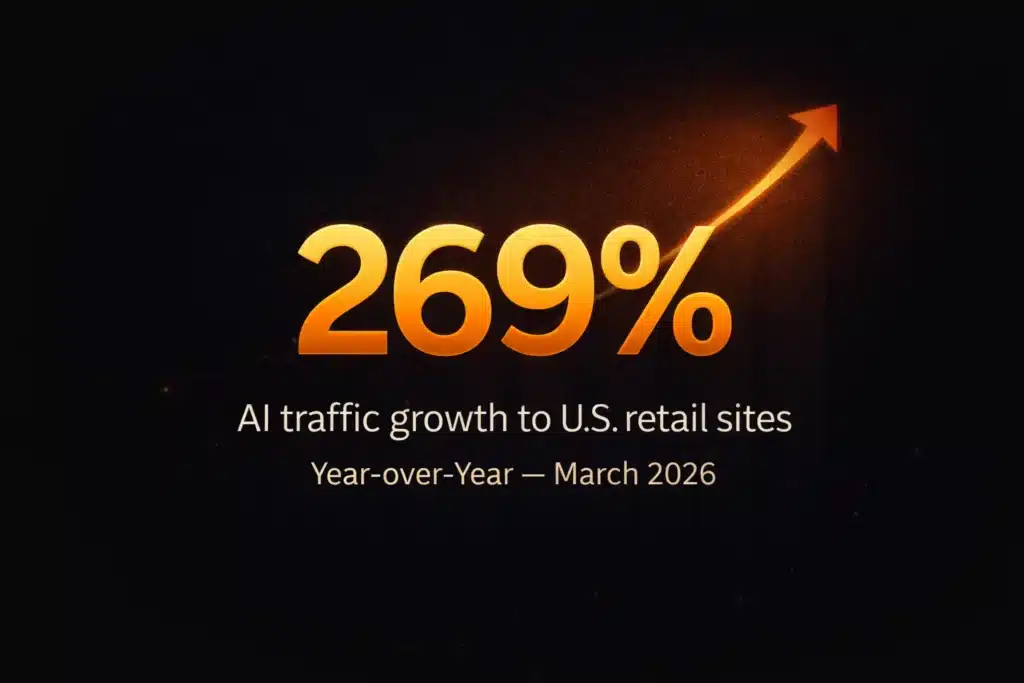
The other reason is AI search. Adobe data shows that AI traffic to US retail sites increased 269% year over year as of March 2026. People are no longer only searching on Google. They are asking ChatGPT, Gemini, and Perplexity for recommendations. Those AI systems cite sources when they answer. Being one of those cited sources is the new SEO.
Semrush had already built tools to track this. Adobe needed those tools to complete its platform.
The Semrush Adobe Merger Impact: Three Layers Nobody Explains Clearly
Layer 1: What Adobe Actually Bought
Most coverage focuses on the price. The more important story is what Adobe now controls.
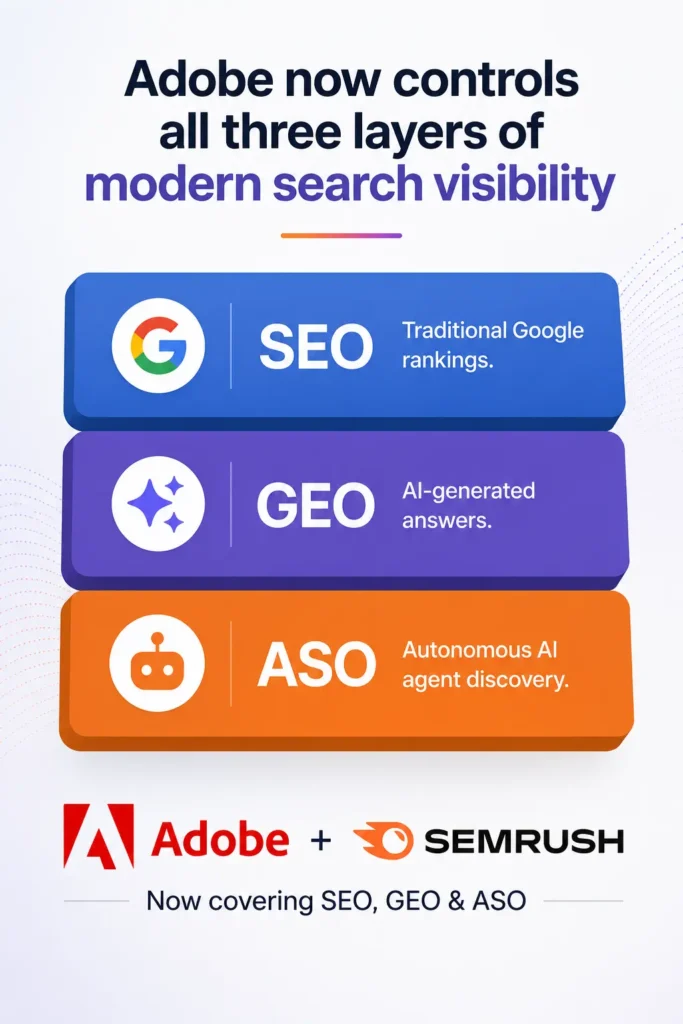
Adobe, through Semrush, now has the data and tooling to serve SEO, GEO (Generative Engine Optimisation, which ensures brands appear in AI-generated answers), and ASO (Agentic Search Optimisation, which ensures brands are discoverable and actionable by autonomous AI agents), a position that Google, HubSpot, and Salesforce will find extremely difficult to replicate quickly.
In plain terms: Adobe can now help a brand create content, distribute it, track how it performs on Google, track how it appears in ChatGPT answers, and optimize for AI agents that make buying decisions on behalf of users. All in one platform.
No other company in the world can currently do all four of those things together.
Layer 2: What This Means for the SEO Industry
Cyrus Shepard noted that with Adobe’s scale and emphasis on the enterprise market, Ahrefs remains the only large independent SEO tool suite on the market.
That is a significant observation. Semrush and Ahrefs were the two dominant independent SEO platforms. Now one of them is owned by a $20 billion software company with enterprise pricing ambitions. Ahrefs is the last major independent player standing.
For SEO professionals, this consolidation matters. It reduces competition at the top of the market. Less competition historically means slower innovation and higher prices for end users.
Layer 3: The Pricing Reality Nobody Is Being Honest About
Among SEO practitioners, the reaction is more guarded. Reddit’s SEO community pointed to Adobe’s pricing model and a track record of acquired platforms where innovation slowed after the deal closed.
Semrush currently costs $139 to $450 per month. Adobe Experience Cloud starts in the thousands per month for enterprise customers. Price adjustments are widely expected in the 12 to 24 months following the close.
Semrush’s official FAQ says subscriptions are safe and pricing will not change “immediately.” That word “immediately” is doing a lot of work in that sentence.
Semrush Adobe Merger: What the SEO Community Is Actually Saying
The reaction from professionals is split clearly into two camps.
The optimistic camp believes Adobe’s resources will accelerate Semrush’s AI capabilities, improve data quality, and create better integrations with content workflows.
The cautious camp has a specific concern that nobody in the optimistic camp has answered directly.
The concern is that consolidation often leads to enterprise-level pricing and fewer choices for smaller teams.
Adobe’s core product portfolio serves enterprise marketing teams. Adobe Experience Cloud, Adobe Analytics, Adobe Experience Manager. These are not tools a solo SEO or a five-person agency buys. They cost more per month than most small businesses make in revenue.
When Adobe looks at Semrush’s 28 million users and decides where to invest product resources, they will optimise for the customers who generate the most revenue. That is enterprise clients. Not the freelancer paying $139 a month.
This does not mean Semrush disappears for small users. It means the product roadmap will increasingly prioritise features that enterprise clients need. The tools that solo SEOs and small agencies rely on most may get less attention and development investment over time.
Adobe Semrush Acquisition Deal: The Figma Warning Nobody Is Learning From
Adobe tried to acquire Figma, the design tool, for $20 billion in 2022. The Figma acquisition is the cautionary case. Regulators in the EU and UK blocked the deal entirely after 18 months of review.
The Semrush deal went through relatively smoothly in comparison. But the Figma situation is worth understanding because it reveals how Adobe thinks about acquisitions.
Adobe does not buy tools to destroy them or fold them immediately. They buy tools to integrate them into their ecosystem over time. With Figma, the plan was to integrate design intelligence into Creative Cloud. The deal failed for regulatory reasons, not strategic ones.
With Semrush, the plan is to integrate search intelligence into Experience Cloud. The regulatory hurdle was cleared. But the integration timeline is long and the direction is clearly enterprise.
The question for current subscribers is not whether Semrush will be shut down. It will not be. The question is whether the Semrush you are using in 2028 will still serve your needs as a small agency or solo operator the way it does today.
What Should You Actually Do Right Now?
This is the section most articles skip because they are either writing for enterprise audiences who do not need this advice or they are too optimistic to give honest practical guidance.
Here is my honest take after four years of reviewing SEO tools and tracking this deal closely.
If you are on monthly billing: Consider whether locking in annual billing at current pricing makes sense for you. Prices are confirmed stable right now. They are not confirmed stable in 2027 or 2028.
If you only use Semrush for rank tracking and site audits: Tools like SE Ranking offer comparable rank tracking accuracy at significantly lower cost. I tested SE Ranking’s rank tracker at 97.2% accuracy across 300 keywords, which actually outperformed Semrush in direct testing. Read my full SE Ranking review for the complete breakdown.
If you use Semrush for its full suite: The platform is still the best all-in-one option available. Nothing changes immediately. Keep using it and watch the next two to three major product updates for signals about which direction Adobe is taking the product.
If you are evaluating Semrush for the first time: The core product is still excellent. But factor in that pricing may increase in the next 12 to 24 months when making your decision between annual and monthly billing.
The One Thing Adobe Cannot Take Away From Semrush
Whatever happens with pricing and integration, the data library Semrush has built over 17 years is virtually impossible to replicate.
The backlink database. The keyword database. The SERP intelligence. Those took 17 years and hundreds of millions of dollars to build. They do not disappear because Adobe now owns the company.
What Adobe adds to that foundation is distribution, enterprise sales, and integration with content creation tools. That combination is genuinely powerful for large brands.
For everyone else, the tool still works. The data is still there. The question is just whether the price stays accessible.
Final Honest Assessment
The Semrush Adobe acquisition is the most significant event in the SEO tools market in over a decade. It validates that search visibility intelligence is now considered enterprise-grade infrastructure, not just a tool for marketers.
For enterprise teams, this is probably good news. More resources, better integrations, and a roadmap that aligns with how large brands think about visibility.
For solo SEOs, freelancers, and small agencies, the honest answer is watch and wait. Nothing has changed today. Something may change in 12 to 24 months. Having a backup plan and knowing your alternatives is simply good practice regardless of what Adobe decides to do.
The deal is done. Semrush is an Adobe company. The SEO landscape has permanently changed.
Frequently Asked Questions
What is the Semrush Adobe acquisition?
Adobe completed its $1.9 billion all-cash acquisition of Semrush Holdings on April 28, 2026. The deal was first announced on November 19, 2025 at $12.00 per share, representing a 77% premium over Semrush’s previous closing price. Semrush now operates as part of Adobe’s CX Enterprise platform.
What does the Adobe Semrush merger mean for current subscribers?
Semrush confirmed that existing subscriptions are safe and pricing will not change immediately. The platform continues to operate for all 28 million users. Price adjustments are widely expected in the 12 to 24 months following the acquisition close as Adobe integrates Semrush into its enterprise ecosystem.
Will Semrush pricing increase after the Adobe acquisition?
Adobe has not announced price increases. However, Adobe Experience Cloud starts at thousands per month for enterprise customers, significantly higher than Semrush’s current $139 to $450 range. Industry analysts widely expect price adjustments in the 12 to 24 months post-acquisition.
What is the Semrush Adobe merger impact on small agencies?
The primary concern for small agencies is that Adobe historically focuses product development on enterprise customers. As Adobe integrates Semrush into its enterprise platform, features and pricing may evolve in ways that favour large organisations over solo operators and small teams.
Is Ahrefs better than Semrush now that Adobe owns it?
Ahrefs is now the only large independent SEO tool suite remaining after the Semrush Adobe merger. Whether it is better depends on your use case. Ahrefs leads on backlink data. Semrush leads on keyword research depth and the new AI visibility features being developed under Adobe. Both remain strong tools for different workflows.
What happened to the Adobe Figma acquisition?
Adobe attempted to acquire Figma for $20 billion in 2022 but EU and UK regulators blocked the deal in 2023 after 18 months of review. The Semrush acquisition proceeded more smoothly, receiving regulatory clearance in the US, EU, and UK and closing on April 28, 2026.
What is GEO and why does it matter for the Semrush Adobe deal?
GEO stands for Generative Engine Optimisation. It refers to optimising content to appear in AI-generated search answers from tools like ChatGPT, Gemini, and Perplexity. Adobe acquired Semrush specifically to build GEO and ASO capabilities into its enterprise platform as AI search traffic grows. AI traffic to US retail sites grew 269% year over year as of March 2026.