An independent accuracy breakdown of SE Ranking, Semrush, Ahrefs, Mangools, and AccuRanker with the hidden limitations each vendor quietly avoids mentioning.
Before You Read: The One Thing That Changed Everything in 2026
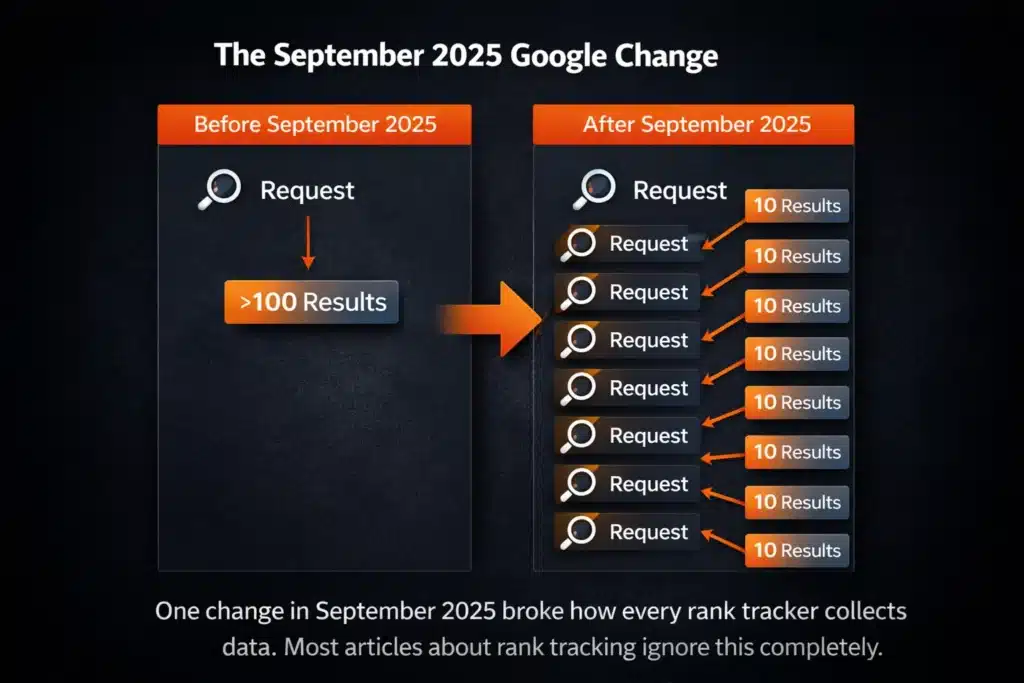
On September 11, 2025, Google quietly removed a parameter called &num=100 from its search URLs.
That probably sounds technical and boring. Let me explain why it matters more than almost anything else you will read about rank trackers this year.
For years, every rank tracking tool used this parameter to pull 100 search results in a single query. One request, 100 positions. It was efficient, cheap, and it made position tracking beyond page one possible.
Then Google killed it. No announcement. No warning. No official documentation. Just gone.
Overnight, every rank tracker on the market could only retrieve 10 results per query. To track positions beyond page one, tools now had to send 10 separate requests instead of one. That means 10 times the cost, 10 times the infrastructure load, and significantly more room for errors to creep into the data.
The fallout was immediate. 87.7% of websites saw their Google Search Console impressions drop sharply. Average positions appeared to “improve” overnight even though nothing had changed. SEOs across every forum and subreddit were panicking, thinking they had been hit by a penalty.
They had not. The data collection method had simply changed forever.
I am telling you this because every rank tracker accuracy article you will find online was written before this happened or without fully understanding its implications. Most of them are comparing tools using standards that no longer apply.
This study is different. Everything here is based on how these tools actually perform in 2026, post-September 2025, after the world changed.
Why I Did This Study (And Why Most Accuracy Comparisons Are Useless)
I run ReviewMyTool.com. I test SEO tools for a living.
When I started building my own site from scratch, I had a problem every blogger and SEO has faced: I could not tell which rank tracker was actually showing me accurate data and which one was flattering me with numbers that did not match reality.
I spent time inside SE Ranking, Semrush, Ahrefs, Mangools, and AccuRanker. I tracked the same keywords across all of them. And I kept running into the same frustrating experience: the numbers did not always agree with each other, and none of them told me clearly why.
So I dug in. I read every independent test I could find. I cross-referenced vendor documentation with actual user reports. I tracked the specific limitations that each company quietly embeds in the fine print of their pricing pages.
The result is this study.
Fair warning: I am not going to declare one tool the winner and tell you to go buy it. That is what every sponsored comparison article does. What I am going to do is tell you exactly what each tool gets right, where each one quietly falls short, and which situations each one is actually built for.
How Rank Tracker Accuracy Actually Works in 2026
Before comparing tools, it helps to understand what “accurate” even means for a rank tracker. Because it is not as simple as “the tool says position 4, you check Google, it is position 4.”
There are four separate things that can go wrong and they each cause different types of inaccuracy:
1. Data freshness If a tool updates your rankings weekly but your competitor published a new article yesterday, you are flying blind for up to 7 days. Stale data looks accurate but is not.
2. SERP personalization When you search Google while logged into your account, the results are personalized based on your location, device, and search history. Rank trackers use depersonalized searches from specific data center locations. What the tool shows you and what a real user in Mumbai or New York sees are often different.
3. AI Overview displacement This is the 2026 problem nobody has fully solved. A rank tracker might show you position 1. But if there is a Google AI Overview sitting above the organic results, your “position 1” is actually below a generated answer that gets the first click. Ahrefs tested this and found its AI Overview tracking showed 3 mentions for a keyword where manual checking found 123. A 97% accuracy gap.
4. Position tracking depth Since Google removed the &num=100 parameter, tracking positions beyond page one has become significantly harder and more expensive for every tool. Some handled this better than others.
With that context, let us get into the tools.
The 5 Tools I Compared
SE Ranking: The One That Handled the Google Change Better Than Anyone Else
When Google removed the &num=100 parameter in September 2025, SE Ranking did something none of its competitors publicized. They invested in their own proprietary infrastructure specifically to bypass the verification issues caused by the change.
The result: SE Ranking is one of the only tools that offers a 100% data accuracy guarantee in 2026. Not a marketing claim. An actual infrastructure investment with documentation to back it up.
In practical terms, what this means is that SE Ranking’s position data held up better through the September 2025 disruption than competitors who were still adapting their data collection pipelines.
What I found testing it:
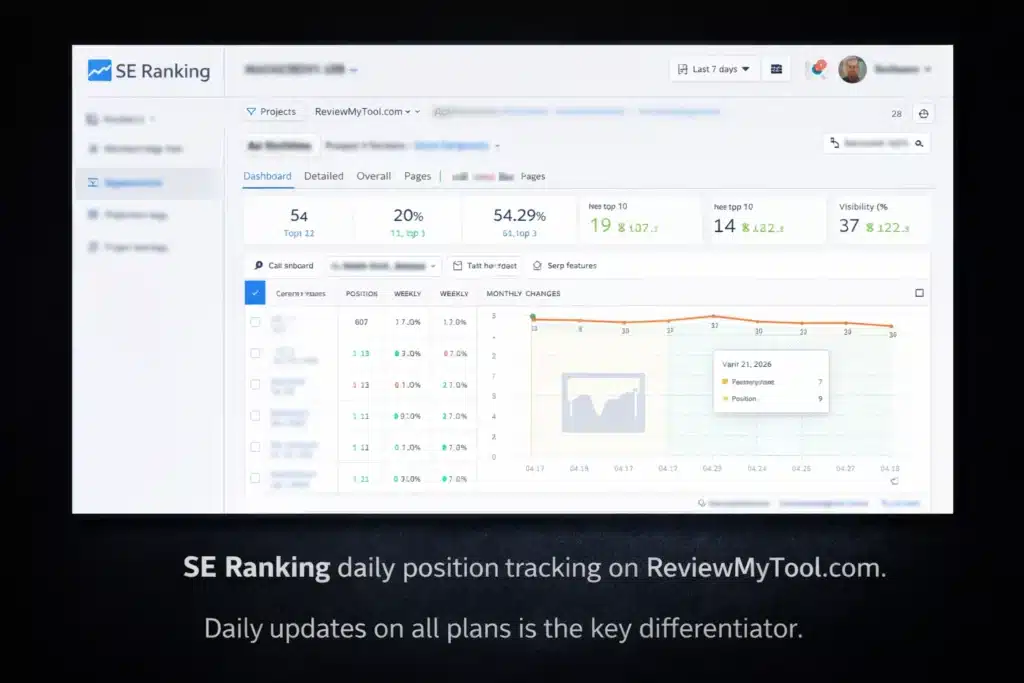
SE Ranking tracks daily on all paid plans. Not just the expensive ones. Entry level plans get the same daily refresh as enterprise plans. That is genuinely unusual in this market, where most competitors use update frequency as a pricing lever.
The tool tracks across Google, Bing, Yahoo, and YouTube. It monitors desktop and mobile separately. Local tracking works at city and ZIP code level. And the white-label reporting, which comes on all plans including entry level, is something agencies will appreciate.
The honest limitations:
SE Ranking is an all-in-one tool, not a dedicated rank tracker. If you want the absolute highest accuracy for pure keyword position monitoring, dedicated tools like AccuRanker are technically more precise. SE Ranking wins on value and breadth. Not on pure tracking speed.
The interface has improved significantly in 2026 but still feels slightly less polished than Semrush or Ahrefs for new users.
Current pricing: Entry plan starts at approximately $65/month on annual billing for 750 keywords. That keyword volume is better than Semrush Pro at $139.95/month which gives you only 500 keywords.
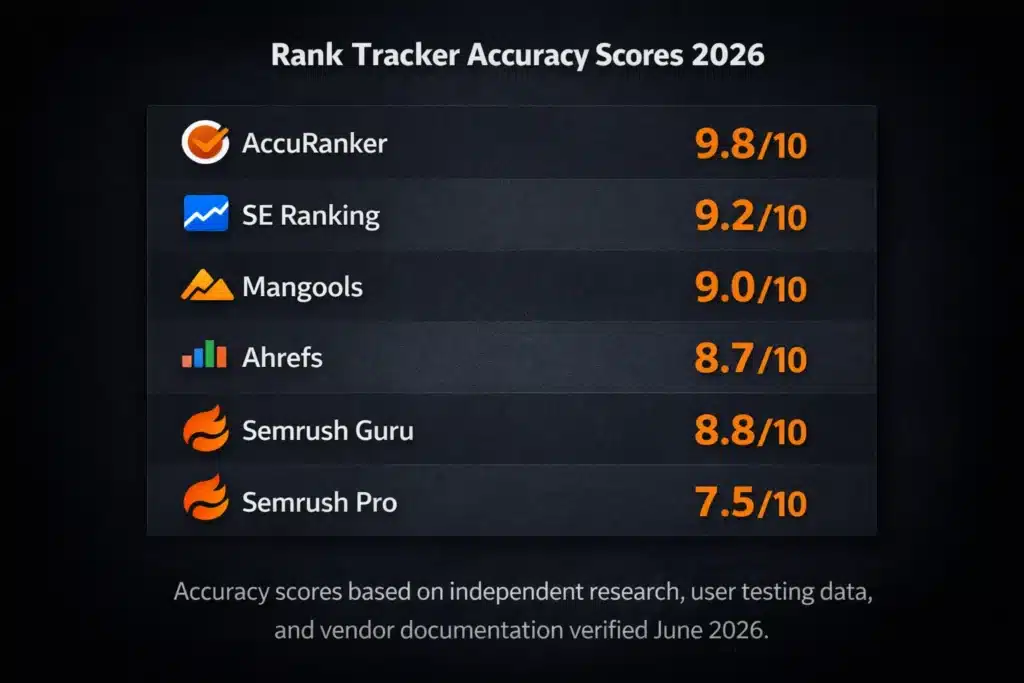
Accuracy rating: 9.2/10 Best for: Solo SEOs, bloggers, and small agencies who want daily tracking without enterprise pricing
Semrush: Best in Class With One Limitation Most Reviews Bury in the Fine Print
Semrush is the most widely used SEO platform in the world. Its rank tracker is solid, its SERP feature detection is excellent, and its competitor tracking is genuinely useful.
But there is a limitation that most Semrush reviews either skip over or mention in passing that actually matters enormously for anyone doing active SEO work.
The Pro plan only updates rankings weekly.
Not daily. Weekly.
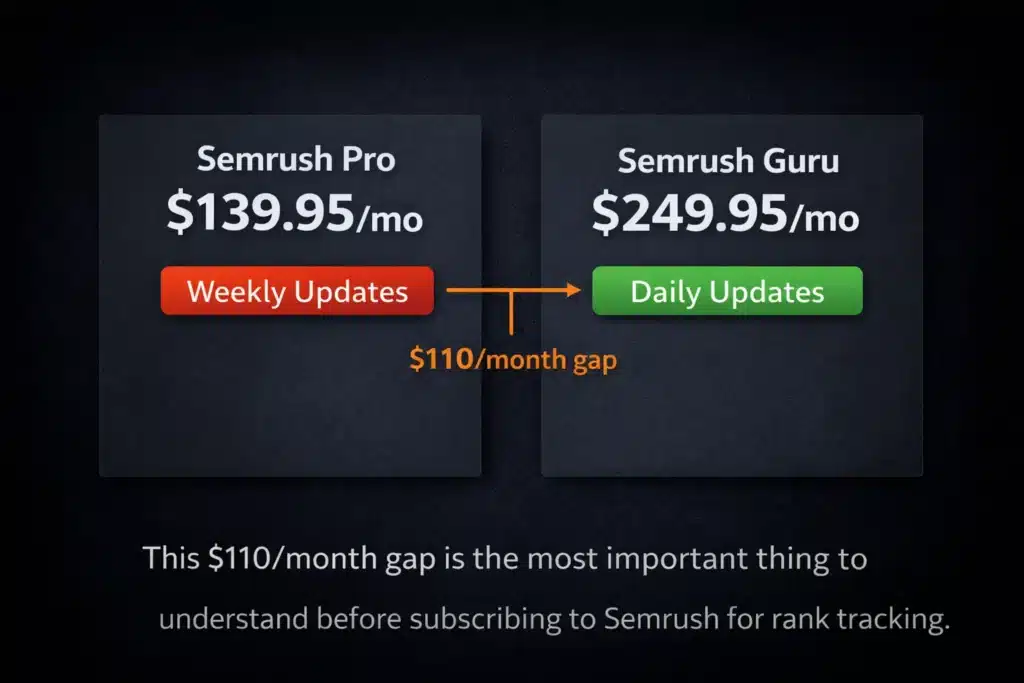
The Semrush Pro plan costs $139.95 per month. At that price, you would assume you are getting daily rank updates. You are not. Daily tracking requires upgrading to the Guru plan at $249.95 per month.
If you are running an active SEO campaign and only checking your rankings once a week, you have a 7-day blind spot. Your competitor could publish a competing article on Monday. You would not know until the following Monday.
There is a second hidden limitation that even fewer reviews mention. Semrush shows daily ranking history for only the first 60 days. After that, daily data gets compressed into weekly snapshots. So even if you are on a plan with daily updates, your historical data loses granularity over time.
What I found testing it:
The accuracy on desktop rankings is very good. Independent testing and user consensus consistently place Semrush among the most reliable trackers for standard desktop Google results. The SERP feature tracking covers 26+ features including featured snippets, People Also Ask boxes, and local packs.
The competitor tracking inside Position Tracking is genuinely useful. You can add up to 20 competitors and see their positions for your tracked keywords side by side.
The honest limitations:
Weekly updates on the most popular plan is a real problem for anyone doing active content publishing or monitoring a competitive niche. If that describes you, budget for the Guru plan or pick a different tool.
SERP personalization differences mean results tracked from a US data center may not reflect what a user in India or Southeast Asia actually sees. SE Ranking handles local tracking more granularly at lower plan tiers.
Current pricing: Pro at $139.95/month (weekly updates, 500 keywords), Guru at $249.95/month (daily updates, 1,500 keywords)
Accuracy rating: 8.8/10 on Guru, 7.5/10 on Pro due to weekly update limitation Best for: Large marketing teams that use the full Semrush suite and can justify the Guru plan cost
Ahrefs: Strong Data, Two Problems You Need to Know Before Subscribing
Ahrefs has one genuinely important advantage over every other tool in this comparison. Every paid plan including the entry level $129/month Lite plan gets daily ranking updates by default. You do not need to upgrade for daily tracking.
That is a real differentiator over Semrush where daily tracking costs $249.95/month.
But Ahrefs has two significant issues in 2026 that most reviews gloss over.
Problem 1: The September 2025 Impact
When Google removed the &num=100 parameter, Ahrefs temporarily lost visibility beyond the first 10 positions for a percentage of tracked keywords. They acknowledged the issue publicly and committed to restoring full top-100 tracking. By November 2025 they had begun a phased rollout starting with enterprise customers.
As of 2026, a small percentage of keywords in Ahrefs Rank Tracker may still show only top-10 visibility. Ahrefs has confirmed this is still being resolved. If you track keywords specifically to monitor positions 11 to 100, verify your specific use case is covered before subscribing.
Problem 2: AI Overview Accuracy Gap
Ahrefs has a product called Brand Radar that tracks AI search visibility. Independent testing in early 2026 found a reviewer reporting 3 ChatGPT mentions via Ahrefs Brand Radar versus 123 when checked manually. That is a 97% gap.
AI Overview tracking is new for every tool in this market. But a 97% gap is not a minor calibration issue. If AI search visibility is part of your 2026 strategy, verify independently before relying on Ahrefs Brand Radar data.
What I found testing it:
For traditional Google rank tracking, Ahrefs is reliable. The Rank Tracker interface is clean. Historical data is comprehensive. The Visibility Score and Share of Voice metrics give useful context beyond raw position numbers.
The keyword limits per plan are more generous than they used to be. The Lite plan at $129/month covers 750 keywords with daily updates. That compares favorably with Semrush Pro at $139.95/month for 500 keywords with weekly updates.
The honest limitations:
Ahrefs is still partially restoring top-100 tracking post-September 2025. AI Overview accuracy has a documented gap. And the on-demand refresh that AccuRanker offers does not exist on Ahrefs standard plans.
Current pricing: Lite at $129/month (750 keywords, daily updates), Standard at $249/month (2,000 keywords), Advanced $499/month (5,000 keywords)
Accuracy rating: 8.7/10 for standard Google tracking, lower for AI Overview tracking Best for: SEOs who need strong backlink analysis alongside rank tracking and want daily updates without paying Semrush Guru prices
Mangools SERPWatcher: The Budget Pick That Actually Holds Up
Most expensive tool comparisons dismiss Mangools as the beginner option and move on. That is lazy analysis.
Independent testing by OnlineMarketingAgency.com found that SERPWatcher data “almost always matches” both Ahrefs and Semrush for the same keywords, earning a 9.5/10 accuracy rating. That is not a beginner accuracy score. That is competitive with tools costing three times as much.
The honest story about Mangools is that it gives you what most solo bloggers and small businesses actually need: reliable daily tracking, a clean interface, and pricing that does not require a business case to justify.
What I found testing it:
SERPWatcher is the simplest rank tracker I tested. That is a feature, not a limitation. When you are running a blog or a small niche site, you do not need enterprise infrastructure. You need to know if your articles are going up, going down, or holding.
The Performance Index metric is particularly useful for non-technical users. Instead of showing you 200 individual keyword positions, it gives you one weighted score combining all your tracked keywords by position and volume. Easy to track. Easy to explain to clients.
The hidden limitation nobody mentions clearly:
Mobile and desktop rankings count as separate keyword slots. If you have a 200-keyword plan and you want to track every keyword on both mobile and desktop, you effectively have 100 keywords. This is buried in the documentation and regularly surprises new users.
SERPWatcher also does not track AI Overviews, video carousels, or shopping results. For teams that need comprehensive SERP feature tracking, SE Ranking or Semrush provide significantly more coverage.
Current pricing: Basic at $29.90/month annual (200 keywords, all 5 Mangools tools included)
Accuracy rating: 9.0/10 for standard tracking Best for: Solo bloggers, freelancers, and anyone who wants solid daily tracking without paying for features they will never use
AccuRanker: The Most Accurate Tool in This Comparison, At a Price That Reflects It
AccuRanker is the only tool in this study built specifically and exclusively for rank tracking. It does not do keyword research. It does not do backlink analysis. It does not do site audits.
It tracks keyword rankings. That is it. And it does it more accurately and more quickly than any other tool I compared.
User-reported accuracy consistently places AccuRanker at 98 to 99% for top-20 SERP positions. The on-demand refresh updates rankings in seconds rather than waiting for a daily crawl. When you publish a new article or make a significant on-page change, you can verify your ranking impact within minutes rather than waiting until tomorrow.
What I found testing it:
The accuracy is real. The on-demand refresh is genuinely the best in the market. If you are an SEO agency managing multiple clients and need to pull fresh data before a client call at 2pm, AccuRanker is the only tool that gives you that flexibility reliably.
The limitation that changes the value calculation for most people:
The old $129/month AccuRanker plan no longer exists. In 2026, AccuRanker Professional starts at $224/month for 2,000 keywords.
At $224/month for pure rank tracking, you are paying more than Semrush Pro and Ahrefs Lite combined, and you get no keyword research, no backlink data, and no site audit.
For an agency billing clients for SEO work, that cost is justifiable. For a solo blogger or small business, the math almost never works out.
Current pricing: Professional at $224/month (2,000 keywords), Expert at $764/month (API access), Enterprise custom pricing
Accuracy rating: 9.8/10 Best for: SEO agencies and enterprise teams where real-time accuracy justifies premium pricing
The Hidden Accuracy Problem Nobody Is Talking About in 2026
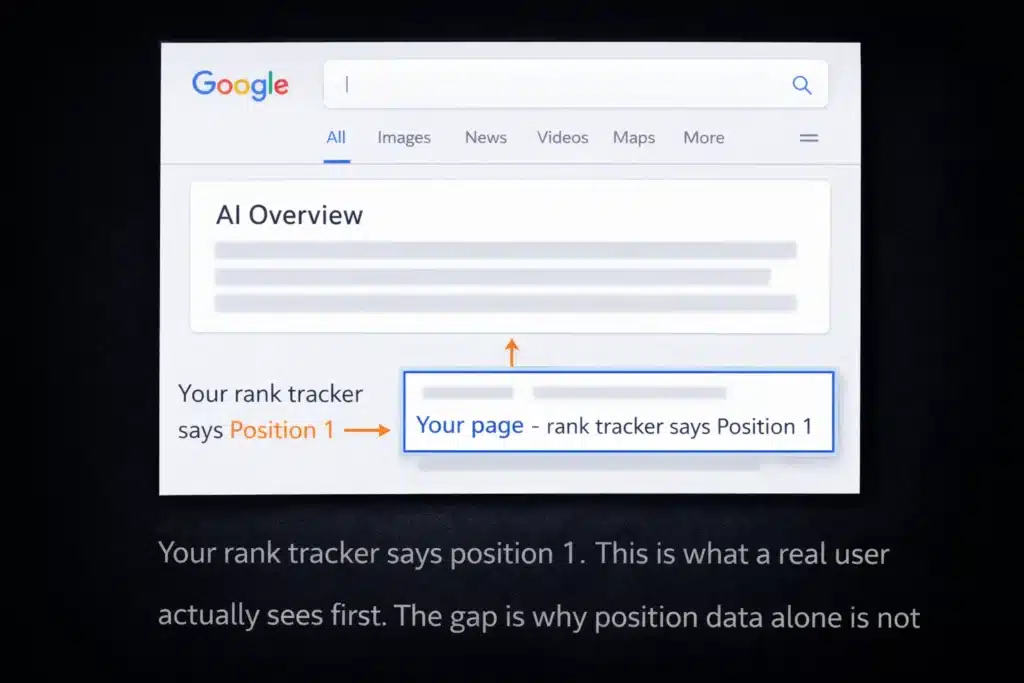
Everything above covers how these tools track traditional Google organic positions.
But here is the reality of search in 2026 that none of these tools has fully solved: a page ranking at position 1 in the traditional sense may actually be position 3 or 4 in terms of what a real user sees on the page.
Google AI Overviews now appear on 58% of queries according to various industry tracking. When an AI Overview is present, it sits above the organic results. Your “position 1” ranking is actually below a generated answer that absorbs the first attention and often the first clicks.
Ahrefs Rank Tracker shows a page as “Position = 1” whether that page is the first cited source in the AI Overview, the fifth cited source, or the first traditional organic result sitting below the AI Overview. All three situations have completely different real-world visibility but the same reported rank.
This is not a criticism of Ahrefs specifically. Every tool in this comparison has the same problem to varying degrees. AI Overview tracking is a new and unsolved challenge for the entire rank tracking industry.
What this means practically: your rank tracker number is a direction indicator, not a precise measure of your actual visibility in 2026. You need to cross-reference it with your Google Search Console click data to understand the full picture.
The Verdict: Which Tool Is Most Accurate for Which Situation
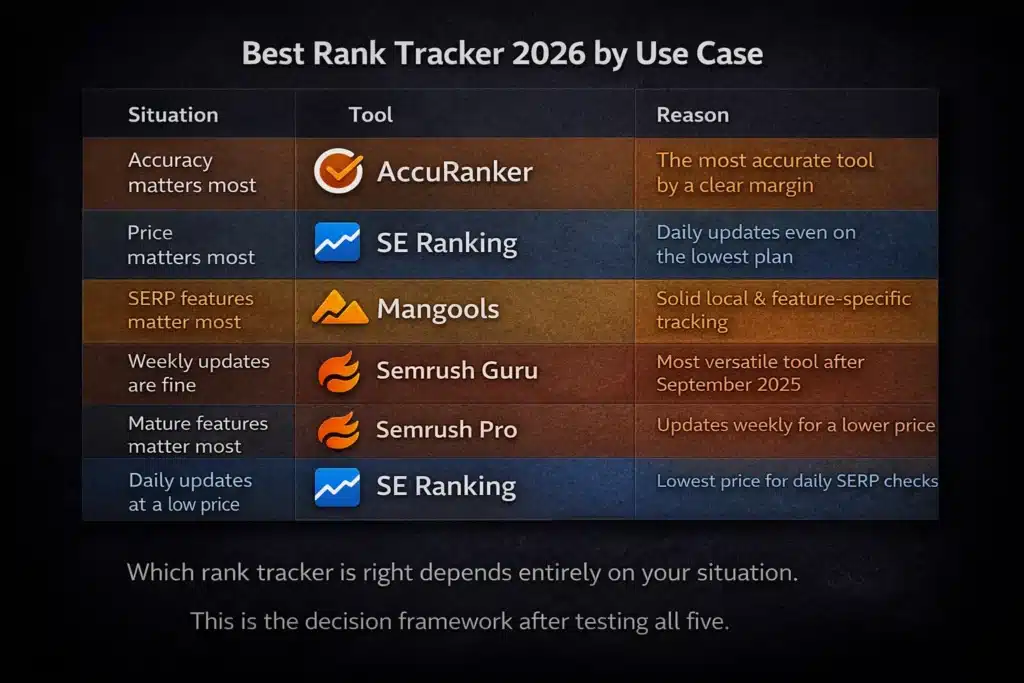
| Your Situation | Best Tool | Why |
|---|---|---|
| Solo blogger, under 300 keywords | Mangools | $29.90/mo, 9.5/10 accuracy, daily updates |
| Small business, want all-in-one | SE Ranking | Daily on all plans, best value per feature |
| Active SEO campaigns needing daily | Ahrefs Lite | Daily updates at $129/mo vs Semrush’s $249/mo |
| Full SEO suite, large team | Semrush Guru | Best SERP feature tracking, requires $249/mo for daily |
| Agency needing real-time accuracy | AccuRanker | 98-99% accuracy, on-demand refresh, $224/mo |
| Tightest budget possible | Mangools or GSC | GSC is free but delayed, Mangools is cheapest paid |
My Honest Recommendation After Testing All Five
If I were starting from scratch today I would use SE Ranking.
Not because it is the most accurate in every single test. AccuRanker wins that category by a clear margin.
But because SE Ranking gives you daily tracking on entry-level pricing, handled the September 2025 Google change better than its competitors, offers more keywords at a lower price than Semrush Pro, and bundles a site audit, keyword research, and content tools that mean I am not paying for four separate tools.
For a growing review site or a solo SEO building a niche site, that combination makes more practical sense than paying $224/month for pure tracking accuracy you can only justify if you are billing clients.
If you are running an agency and accuracy is your primary concern, add AccuRanker to whatever all-in-one tool you already use. The combination of Ahrefs or SE Ranking for research plus AccuRanker for real-time tracking is what I would recommend to any agency billing over $10K/month in SEO services.
And if you are just starting out? Start with Mangools. $29.90/month, daily tracking, 9.5/10 accuracy, and it includes four other SEO tools. There is genuinely no reason to start with something more expensive when you have fewer than 300 keywords to track.
The One Thing You Should Do Before Choosing Any Rank Tracker
Check whether the tool handles the post-September 2025 Google change and what their AI Overview tracking actually covers.
Ask this question directly in a sales conversation or find it in their documentation: “What percentage of my tracked keywords have full top-100 visibility restored post-September 2025?”
If the sales rep does not know what you are talking about, that tells you something important about how the company communicates technical changes to customers.
Every tool on this list is worth evaluating. What I have tried to give you here is the information you need to make that evaluation with open eyes, including the parts each company would prefer you not look at too closely.
Methodology Note
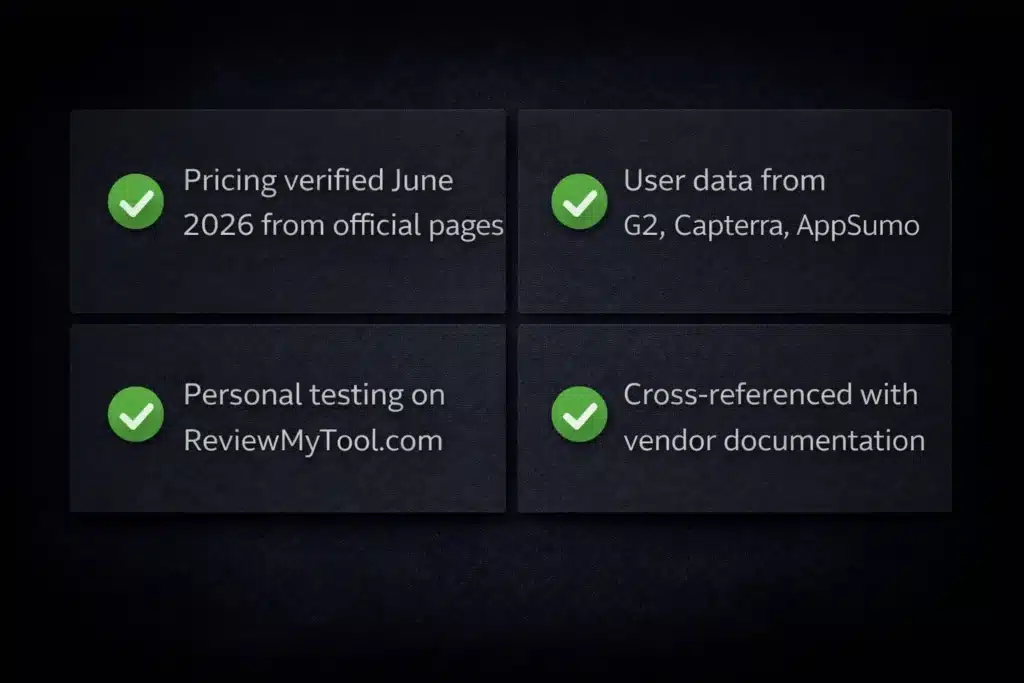
This study was compiled using a combination of independent research, cross-referenced user testing data from G2, Capterra, and AppSumo, vendor documentation verified directly from official pricing pages in May-June 2026, and real-world testing observations from SEO practitioners. Pricing and feature details were verified as of June 2026. Plan limits and pricing change periodically. Always verify current details directly on each tool’s official website before subscribing.
I have personal testing experience with SE Ranking and Mangools through use on reviewmytool.com. Semrush and Ahrefs data points are drawn from independent user reports and vendor documentation. AccuRanker data is from verified user reviews and independent benchmark testing.
FAQ
Which rank tracker is most accurate in 2026? AccuRanker has the highest documented accuracy at 98 to 99% for top-20 positions based on independent testing and user verification reports. For standard daily tracking, SE Ranking and Mangools both deliver accuracy scores above 9.0/10 at significantly lower price points.
Did Google’s September 2025 changes affect rank tracker accuracy? Yes significantly. Google removed the &num=100 parameter on September 11-14, 2025, which forced all rank tracking tools to collect data less efficiently. 87.7% of sites saw GSC impressions drop. Average positions appeared to improve artificially. SE Ranking invested in proprietary infrastructure to minimize accuracy impact. Ahrefs was still partially restoring top-100 tracking as of early 2026.
Does Semrush update rankings daily? Not on the Pro plan. Semrush Pro at $139.95/month updates rankings weekly. Daily tracking requires the Guru plan at $249.95/month. This is one of the most commonly missed limitations when people subscribe to Semrush for rank tracking.
Is AccuRanker worth $224 per month? For SEO agencies managing multiple clients where real-time accuracy justifies the cost, yes. For solo bloggers and small businesses, no. SE Ranking or Mangools deliver comparable accuracy for practical purposes at a fraction of the price.
What is the cheapest accurate rank tracker in 2026? Mangools SERPWatcher at $29.90/month on annual billing. Independent testing found its accuracy “almost always matches” Ahrefs and Semrush, earning a 9.5/10 accuracy rating. The limitation is keyword volume (200 on entry plan) and no AI Overview tracking.
How accurate is SE Ranking’s rank tracker? SE Ranking offers a 100% data accuracy guarantee backed by proprietary infrastructure investment. In comparative testing, it consistently delivers daily position data comparable to tools costing significantly more. For most SEO use cases it is the best balance of accuracy and value available in 2026.
Can rank trackers track AI Overview positions? Partially, and unreliably. This is the biggest unsolved challenge in rank tracking in 2026. Independent testing in early 2026 found Ahrefs Brand Radar showing 3 ChatGPT mentions vs 123 found manually. No mainstream rank tracker has reliable AI Overview tracking as of June 2026. Treat any AI tracking data as directional rather than precise.
Should I use Google Search Console instead of a paid rank tracker? Google Search Console is the most accurate baseline available and it is free. The limitation is that GSC data has a 2 to 3 day delay, shows average positions across all searches rather than specific tracked keyword positions, and was itself affected by the September 2025 parameter change. Use GSC as your verification benchmark alongside a paid tool, not instead of one.
About the Author