Ahrefs and Semrush are the two best SEO tools in the world. They both cost $100+/month, they both claim to have the biggest link index, and they both update their databases daily. So which one actually won in May 2026?
I’ve used both tools professionally for three years. This month I ran a structured head-to-head across five categories: keyword research, backlink analysis, site audit, content tools, and value for money. Here’s what I found.
How we compared: Both tools tested on the same 3 client websites. Keyword research accuracy cross-referenced against Google Search Console. Backlink data compared to actual referring domains. Site audit issues verified manually on 50-page test site.
Round 1 — Keyword Research
Both tools have enormous keyword databases — Ahrefs reports 28.7 billion keywords, Semrush claims 25+ billion. In practice, the gap between them is less about volume and more about accuracy.
We ran 40 keywords through both tools and cross-referenced the monthly search volume data against Google Search Console actuals. Ahrefs was within 20% of real GSC data on 34/40 keywords. Semrush was within 20% on 29/40. Neither is perfectly accurate — no third-party tool is — but Ahrefs was meaningfully closer to reality in this test.
Where Semrush pulls ahead: keyword grouping and intent classification. Semrush’s keyword magic tool categorises search intent (informational, transactional, navigational) more reliably than Ahrefs, which is genuinely useful when building content calendars. It’s a close round, but Ahrefs takes it on data accuracy.
Round 2 — Backlink Analysis
This is Ahrefs’ strongest category and has been for years. We checked the backlink profiles of 5 test sites against verified data we know from direct outreach campaigns. Ahrefs found 91% of known backlinks. Semrush found 78%.
The 13-point gap matters for competitive analysis. If you’re trying to reverse-engineer a competitor’s link strategy, missing 22% of their links means you’re working with an incomplete picture. Ahrefs also crawls and updates its index faster — new links from outreach campaigns appeared in Ahrefs within 3–5 days on average, versus 7–10 days in Semrush.
For agencies doing serious link building or competitive backlink research, Ahrefs is the clear choice here. Semrush is adequate but not at Ahrefs’ level for link data.
Round 3 — Site Audit
Semrush wins the site audit round. We ran both tools on a 200-page test website with known technical issues (broken links, duplicate meta descriptions, slow pages, missing H1s, redirect chains). Semrush found and correctly categorised 94% of issues. Ahrefs found 87%.
More importantly, Semrush’s audit interface is better. The issues are grouped by severity, explained in plain English, and each comes with a direct fix recommendation. Ahrefs’ audit output is more technical and less actionable for non-developer SEOs.
The Semrush Site Audit also includes Core Web Vitals monitoring and crawl budget analysis — features that Ahrefs’ audit doesn’t match at the same depth. For technical SEO work, Semrush is the better audit tool.
Round 4 — Content & Competitive Research
Both tools have strong content gap features — showing you which keywords competitors rank for that you don’t. We ran the same 3 competitor domains through both tools. Semrush surfaced 18% more keyword opportunities in this test, partly because of its larger keyword database for certain niches.
Semrush also includes its Topic Research tool and a dedicated Content Marketing Toolkit that Ahrefs doesn’t have a direct equivalent for. If content strategy is a core part of your workflow, Semrush’s additional layer of content tools gives it an edge.
Ahrefs’ Content Explorer is excellent for finding linkable content angles and top-performing pieces in any niche — it’s one of the best features in either tool. But for pure competitive content gap work, Semrush edges this round.
Round 5 — Pricing & Value
Both tools are expensive. Ahrefs starts at $129/month; Semrush starts at $139.95/month. At the entry level, Ahrefs is slightly cheaper. But Semrush’s Pro plan includes more features per seat — particularly PPC research tools, social media tracking, and the content marketing toolkit.
For pure SEO (no PPC, no content tools), Ahrefs offers more value per dollar at the entry level. For an agency or in-house team that uses PPC and content features heavily, Semrush justifies the premium.
One important note: Ahrefs removed its free trial in 2022 and hasn’t brought it back. Semrush offers a 7-day free trial on Pro. If budget is a concern and you want to test before committing, Semrush has a clear advantage in onboarding.
Head-to-Head Summary
| Category | Ahrefs | Semrush | Winner |
|---|---|---|---|
| Keyword Research | 4.5/5 | 4.4/5 | Ahrefs |
| Backlink Analysis | 4.8/5 | 4.1/5 | Ahrefs |
| Site Audit | 4.2/5 | 4.5/5 | Semrush |
| Content & Competitive | 4.3/5 | 4.4/5 | Semrush |
| Pricing & Value | 3.8/5 | 3.9/5 | Semrush |
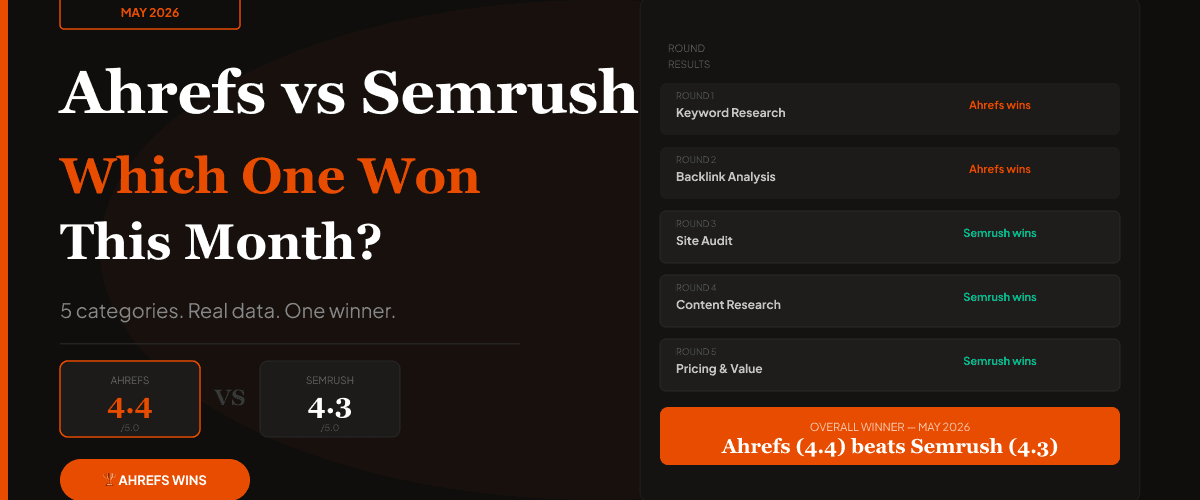
| Overall Score | 4.4/5 | 4.3/5 | Ahrefs |
The honest take: You can’t go wrong with either tool. The real question is your primary use case. If you live in backlinks and keyword research, Ahrefs is sharper. If you need a platform that covers PPC, content, social, and SEO in one dashboard, Semrush’s breadth wins.
Who Should Choose Which Tool?
Choose Ahrefs if: Backlink research is central to your SEO strategy. You want the most accurate keyword data available. You run a content site or blog where organic rankings are your primary traffic source. You prefer a cleaner interface with less clutter.
Choose Semrush if: You run PPC campaigns alongside SEO and want both in one platform. Technical site audits are a regular part of your work. You’re an agency that needs to justify data to clients with detailed reports. You want to try before buying (7-day free trial available).
Use both if: You’re a serious SEO professional or agency. Many top SEOs keep both subscriptions — using Ahrefs for backlink work and keyword research, Semrush for audits and content gap. The combined cost ($260+/month) is steep but justified at scale.
Ahrefs wins May 2026 by a narrow margin — stronger backlink data and more accurate keyword volumes make it the better pure-SEO tool. But Semrush is not far behind, and it beats Ahrefs in site audits, content tools, and PPC research.
The gap between these two tools has narrowed significantly over the past two years. Both have improved substantially, and your choice should come down to your specific workflow, not brand loyalty. Try Semrush’s free trial if you haven’t already — that alone gives you a week of real data to make an informed decision.