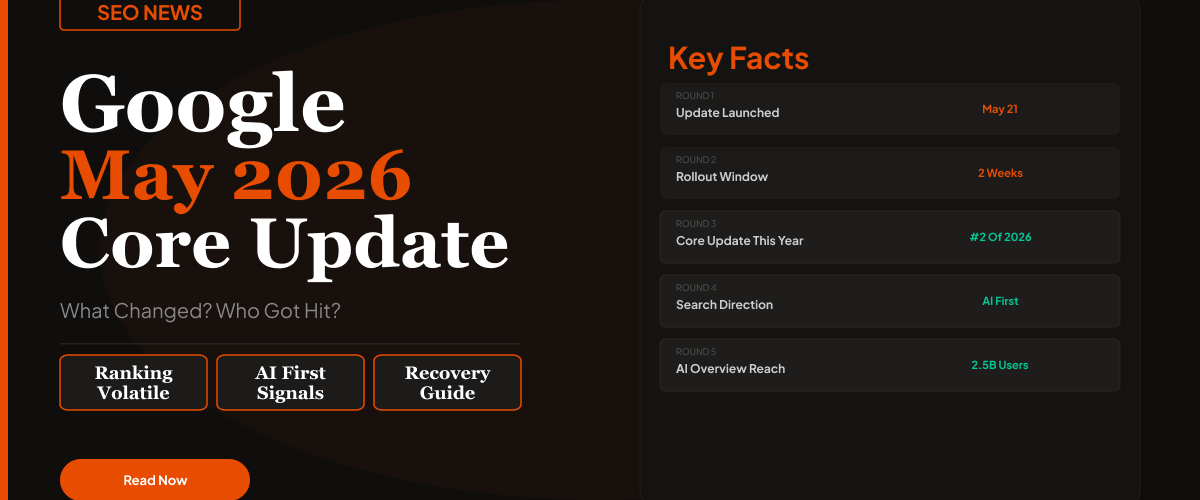
Google’s May 2026 Core Update:
What Actually Changed — and What You Must Do Now
Google dropped its second core update of the year on May 21, just days after the most significant AI search overhaul in Google’s history at Google I/O 2026. If your rankings moved, this explains why. If they didn’t yet, they might still.
Let me be honest with you. When Google drops a core update the same week it announces a fundamental redesign of how search works, it is not a coincidence. The timing of the May 2026 Core Update — landing just two days after Google I/O 2026 — is the most important context most articles are missing entirely.
This is not just a routine algorithm tweak. Google is beginning to align its ranking signals with the direction AI search is heading. Understanding that changes everything about how you should respond.
What Google Actually Said (And What They Left Out)
Google’s official announcement was brief. Posted to the Google Search Status Dashboard on May 21 at 8:40 AM Pacific, it read: “a regular update designed to better surface relevant, satisfying content for searchers from all types of sites.”
No companion blog post. No specific targets named. No list of what changed.
This is standard Google behaviour with core updates. They rarely tell you exactly what shifted because the algorithm has hundreds of signals updating simultaneously. What Google does tell you, consistently and repeatedly, is to focus on creating “helpful, people-first content.” That phrase has been their answer for four years. But right now, in May 2026, it means something more specific than it used to.
“We launched this update immediately after I/O where we announced a new era for AI Search. That is not a coincidence. Google is stress-testing its ranking signals for an AI-first world.”
— Analysis, Search Engine Journal, May 2026The Google I/O 2026 Connection Nobody Is Talking About
Two days before this core update dropped, Google announced sweeping changes to how search works at Google I/O 2026. If you missed it, here is what changed:
- AI Overviews and AI Mode merged into one seamless AI Search experience, live worldwide immediately
- Gemini 3.5 Flash became the new default model powering AI Mode in search
- AI Overviews now reaches 2.5 billion monthly users, which is nearly a third of the planet
- AI Mode crossed 1 billion monthly users, with queries more than doubling every quarter
- Information Agents launched: an AI system that monitors the web 24/7 on your behalf and surfaces updates
- The search box itself was redesigned into an intelligent, multimodal input accepting text, images, video and files
Why does this matter for the core update? Because AI Overviews pull content from web pages to generate answers. Google needs its ranking signals to surface pages that are genuinely useful as source material for AI responses, not just pages built for the old ten-blue-links world. The May core update is Google recalibrating for that new reality.
🌐 The Bigger Picture: AI-First Search Is Here
AI Overviews now reaches 2.5 billion people monthly. AI Mode has 1 billion users. Queries are doubling every quarter. Search traffic is not going away. But how you earn it is fundamentally different from 2023.
The sites winning in this environment are not the ones with the most backlinks or the most keyword-stuffed pages. They are the ones whose content is genuinely quotable, genuinely useful, and genuinely written by people who know what they are talking about. That is what “helpful content” actually means in 2026.
Who Got Hit by the May 2026 Core Update?
Early data from SEO tracking tools shows ranking volatility concentrated in specific sectors. Here is what the first week of data looks like:
| Sector | Impact | Direction | Why |
|---|---|---|---|
| Finance & Investing | High | ▼ Drops | YMYL signals scrutinised heavily; thin AI content hit hardest |
| Health & Medical | High | ↕ Mixed | Authoritative medical sources rising; aggregator sites falling |
| E-commerce | Moderate | ▼ Drops | Thin product pages and copied manufacturer descriptions penalised |
| AI Tool Reviews & SaaS | Moderate | ↕ Mixed | First-hand tested reviews rising; templated roundups falling |
| News & Publishing | Low–Moderate | ▲ Gains | Original reporting and timely analysis rewarded |
| Local Services | Moderate | ↕ Mixed | E-E-A-T signals and reviews quality re-weighted |
| Topical Authority Sites | Low | ▲ Gains | Deep, consistent coverage of a niche continues to win |
Exactly What Got Penalised vs Rewarded
🔴 Getting Hit
- High-volume AI-generated content with no human editing or original perspective
- Thin informational pages that answer the headline but add no depth
- Aggregator articles that compile information available on 50 other sites
- Ad-heavy pages where content is secondary to monetisation
- Pages with no clear author, no credentials, no first-hand experience signals
- Sites with strong backlinks but weak, unoriginal on-page content
- Content that exists to rank, not to genuinely help a real person
🟢 Getting Rewarded
- Original research, original testing, first-hand experience documented in detail
- Clear author expertise, meaning named authors with verifiable backgrounds
- Content that satisfies the full user intent, not just the top-level query
- Sites with genuine topical authority built consistently over time
- Pages that cite primary sources and include real data points
- Content that gets cited by AI Overviews as a reliable source
- Fast, clean, mobile-optimised pages with low ad density
The Recovery Checklist: 7 Things to Do Right Now
If your traffic dropped after May 21, here is the sequence that matters. Work through it methodically, one step at a time:
-
1Diagnose before you act
Open Google Search Console. Filter by date range: May 1–20 vs May 21–27. Sort pages by traffic drop. Identify the 10 pages that lost the most impressions. Those are your problem pages. Do not guess; look at the data first.
-
2Audit your hit pages for thin content
For each page that dropped, ask honestly: does this article tell the reader something they cannot find on five other sites? Does it include real examples, real data, or real first-hand experience? If the answer is no, that is why it dropped.
-
3Add first-hand experience signals
Google’s E-E-A-T framework prioritises Experience as the first E. If you tested a tool, describe exactly what happened when you used it. If you applied a strategy, show the result. Screenshots, data, timestamps: all of these signals tell Google your content is real, not assembled.
-
4Fix your author signals
Every article needs a named author with a linked author bio that establishes expertise. If your posts say “Admin” or “Staff Writer” with no bio, fix this immediately. Google cannot establish E-E-A-T on a page with no identifiable author.
-
5Satisfy full search intent, not just the keyword
Read the top 3 ranking pages for your target keyword. Write down every question a user might still have after reading them. Then answer those questions in your article. The page that fully satisfies intent wins. Partial answers rank partially.
-
6Build topical authority, not just individual pages
One great article does not build topical authority. A cluster of interconnected articles on a subject does. If you want to rank for SEO tools, you need 10–15 articles covering different angles of the topic, all internally linked. Google rewards sites that own a subject, not sites that publish one good page about it.
-
7Do not expect instant recovery. Start today anyway.
Core update recovery takes three to six months in most cases. The biggest visible recovery typically comes with the next core update. That does not mean wait. It means the work you do this week is what Google will confirm three months from now. Start immediately.
Update Timeline: What Happened and What Comes Next
The March 2026 Core Update rolled out and completed by April 8. Focused on quality signals and continued rewards for helpful content. Thin AI content sites saw early losses.
Google announces “A New Era for AI Search.” AI Overviews and AI Mode merge. Gemini 3.5 Flash becomes default. Information Agents launch. The search box is redesigned. This is the biggest single-day change to how Google Search works in years.
Google officially confirms the May 2026 Core Update at 8:40 AM Pacific. Rollout begins immediately. Ranking volatility detected across multiple sectors within 24 hours.
Rollout expected to complete within two weeks of launch. After this date, rankings should stabilise enough for meaningful before/after analysis.
Historically, Google releases core updates every 6–10 weeks. Based on that pattern, the next core update is likely in July or August 2026. That is your window to show Google meaningful improvement on the pages that dropped.
What This Means If You Run a Review or Affiliate Site
This section is directly relevant to what we do at ReviewMyTool, and to thousands of niche site owners dealing with the same situation right now.
The May 2026 Core Update is specifically hard on review content that lacks first-hand testing. If you are publishing tool reviews that summarise features from the vendor’s own website, you are ranking on borrowed time. Google can increasingly tell the difference between a page that describes a tool and a page written by someone who actually used it. It is prioritising the latter.
The winning formula for review and affiliate content right now:
- Real usage data: Screenshots, actual outputs, time spent, specific things that broke
- Honest negatives: Pages that only say positive things about every tool they review are not trusted by users or by Google
- Comparison depth: Not just “Tool A vs Tool B” but the specific scenario where each one wins
- Updated regularly: A review published in 2023 and never touched since is being outranked by fresher, updated content
- Author authority: A review written by someone with a name, a face, a bio, and documented expertise in the niche
🔧 Track Your Recovery With the Right SEO Tools
You cannot fix what you cannot measure. If you are monitoring your rankings through a core update, you need reliable rank tracking and site audit tools. We have tested and reviewed the best options so you can pick the right one for your budget.
The Bottom Line
The May 2026 Core Update is not a punishment. It is Google getting better at answering a question it has always been trying to answer: which page genuinely helps the person searching?
If your content truly helps people, if it is written by someone with real expertise and tested with real hands, this update is not your enemy. It is the mechanism that is supposed to surface you above the sites that have been beating you with volume and backlinks but delivering less value.
The sites that dropped deserve to investigate why honestly. The sites that rose earned it. And the sites sitting in the middle, doing okay but not quite thriving, have their clearest roadmap yet for what to fix.
Start with your Google Search Console data. Work through the checklist above. Then give it time.