When I first heard about Koala AI, I assumed it was just another bulk content tool with a friendly name slapped on it but after testing and reviewing it, I was partly wrong, but not entirely.
Koala AI is an AI writing tool built specifically for bloggers and SEO content creators. It pulls live data from Google search results to write articles that are actually structured around what's currently ranking. That's its biggest edge. The biggest weakness? It still produces output that needs real editing before it sounds like a human wrote it. If you're expecting publish-ready content, you'll be disappointed. but that what i think if you really want to rank it needs to be checked and some edits before publishing in any tool so i decided to test it further.
I'm Dharmesh Talaviya and I run ReviewMyTool.com. I generated 23 articles across four weeks and spent $47 in credits doing it. Here's what I actually found.
I actually picked this koala ai in my top 5 pick which list i already shared on medium.
Quick Verdict
| Factor | Rating | Notes |
|---|---|---|
| Overall Rating | 4/5 | Solid for SEO-first blog content |
| Ease of Use | 4/5 | Genuinely beginner-friendly |
| Output Quality | 3/5 | Good structure, needs editing |
| SEO Usefulness | 3.5/5 | Real-time SERP awareness is a strong advantage |
| Pricing Value | 3/5 | Fair at lower tiers, gets pricey for heavy users |
| Best For | Bloggers, niche site owners, freelance writers | |
| Biggest Limitation | Repetitive phrasing across long articles | |
| Final Recommendation | Yes, worth trying if you publish SEO content regularly |
Who Should (and Should NOT) Use This Tool
This tool is a good fit for you if:
- You run a blog or niche site and need to publish consistently
- You understand basic SEO and want AI to handle the first draft
- You work as a freelancer managing multiple client websites
- You want an AI writer that pulls from what's actually ranking on Google right now
- You're a beginner who finds tools like Jasper too complicated
This tool is probably NOT a good fit if:
- You want fully publish-ready content with zero editing
- You write in a highly technical field where accuracy is critical (law, medicine, finance)
- You need AI-generated ad copy, product descriptions, or email campaigns as the primary use case
- You're building a content team at scale and need an enterprise-grade workflow
- You want a tool that generates truly unique opinions and perspectives rather than search-optimized summaries
Realistic expectation: Koala AI speeds up your writing significantly. It does not replace your editorial judgment. Plan to spend 20-40% of your total time editing and fact-checking.
What Surprised Me Most
When I started testing, I expected the usual AI writing experience: a prompt box, some generic output, and lots of rewriting. What I didn't expect was how much thought had gone into the SERP-aware writing mode.
But the thing that genuinely caught me off guard was the word credit system. If Koala AI generates a junk output on an article, you lose those credits anyway. No refund. No retry credit. Gone. I lost credits twice on articles where the output was so repetitive I deleted the whole thing and started over. Most reviews completely miss this. It is the one thing I would want to know before subscribing.
When I entered a keyword like "best project management tools for freelancers," Koala AI actually pulled in what was ranking on Google at that moment and structured the article around the common headings and angles it found. That sounds simple, but it saves a surprising amount of time at the outline stage.
What also surprised me was the KoalaLinks feature. It automatically embeds relevant internal and external links into the article as it writes. I expected it to be spammy or forced, but most of the link placements were actually reasonable. Not perfect, but better than I assumed.
The frustration I didn't see coming? The articles start to feel oddly similar after you generate a few. The sentence construction, the way lists are built, the transitions between sections... they have a recognizable pattern after a while. If you're publishing 20 articles a month from Koala AI on one site, a careful reader will start to notice.
Also: the tool is quite opinionated about article structure. If you want something unconventional, like a narrative-style post or a deeply personal opinion piece, you'll fight the defaults constantly.
Key Features Tested
KoalaWriter (AI Blog Post Generator)
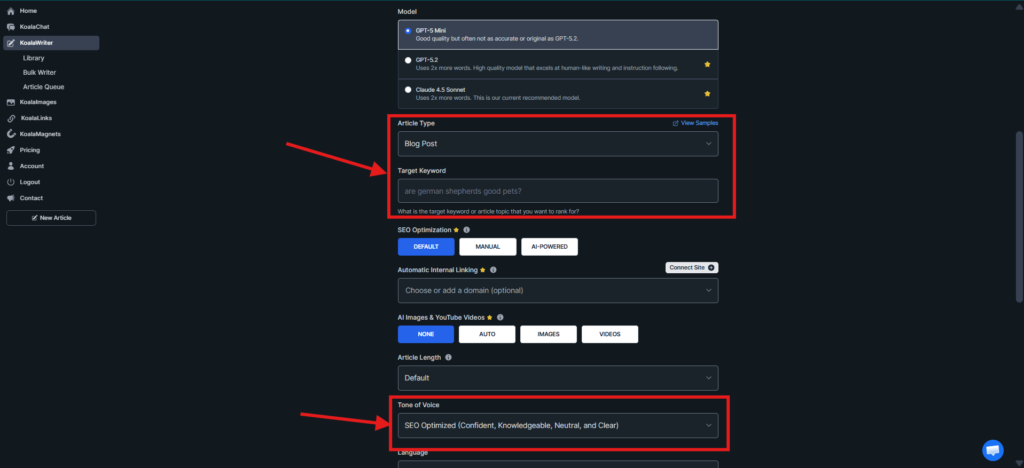
This is the core product. You enter a keyword, choose your target audience and tone, set the article length, and let it run. The output is usually between 1,500 and 3,500 words depending on your settings.
In practice, the output is well-structured. Headings are logical, sections flow reasonably, and it generally covers the subtopics you'd expect for a given keyword. The problem is that "covers the subtopics you'd expect" is also the ceiling. It rarely surfaces anything surprising or adds a perspective competitors haven't already covered.
I tested it on a keyword like "how to start a dropshipping business" and the output was solid: clear steps, decent explanations, a reasonable FAQ at the end. But it read like a confident summary of existing articles rather than an original take. For SEO purposes, that might be enough. For building a genuinely authoritative site, it won't be.
Where it works well: Informational content, comparison articles, listicles, how-to posts in non-technical niches.
Where it struggles: Technical topics, niche markets where accuracy matters, and anything requiring genuine expertise or a distinct voice.
Editing required: Usually 25-35 minutes per article to tighten phrasing, fix repetition, add original examples, and verify facts.
Real-Time SERP Integration
This is what separates Koala AI from tools like Jasper or Copy.ai in a meaningful way. Before generating, Koala AI scans the current top results for your target keyword and uses them to inform the article structure.
In my testing, this produced noticeably better-structured outlines than tools that don't do this. The H2s and H3s actually matched what users were looking for.
One thing I noticed: the tool doesn't always pick up very recent SERP changes. If there's been a major algorithm update or a news event affecting search results, there can be a lag. Not a dealbreaker, but worth knowing.
KoalaLinks
KoalaLinks is a feature that automatically adds internal and external links throughout the generated article. You can connect your own site to provide a pool of internal links, which is useful if you're managing a site with existing content.
Honestly, this feature is convenient but not something I'd trust blindly. Some of the external link choices were fine. Others linked to sources I wouldn't personally choose. I'd review every link the tool inserts before publishing.
Internal linking worked better when I fed it a proper site URL with good crawlable structure. On smaller sites or newer domains, the internal link suggestions were thin.
Amazon and Affiliate Product Integration
Koala AI has a dedicated mode for Amazon affiliate content. You can use it to generate product reviews and roundups that pull product data and integrate affiliate links.
I didn't test this deeply since I don't use affiliate links on my reviews, but I did run a few test generations. The output was functional for someone running an affiliate site in a general niche. For very specific or technical product categories, you'd still need to add real hands-on knowledge.
Bulk Generation
You can queue up multiple articles and generate them in batch. This is useful for agencies managing large content pipelines.
The quality in bulk mode matched single-article mode in my testing. No significant drop in output. The main limitation is your word credit balance, which burns through quickly when you're generating long articles in bulk.
Real Testing Experience
Over four weeks, I tested Koala AI on the following content types:
Week 1: Informational blog posts I generated five articles on software and productivity topics, each targeting keywords with 1,000 to 5,000 monthly searches. Keywords like "how to use Notion for project management" and "best free invoicing tools for freelancers."
The output was solid. Well-structured, covered the right angles, and only needed moderate editing. I spent about 30 minutes editing each article. The biggest issue was a tendency toward filler phrases like "it's worth noting that" and "this is particularly useful for" appearing multiple times per article.
Week 2: Comparison articles "Trello vs Asana vs Monday.com" style content. This is where Koala AI performed best, actually. The comparison structure was logical, the pros and cons were sensibly organized, and the SERP-aware mode helped make sure the article hit the right angles.
Week 3: Technical content I tried a few articles in mildly technical areas, specifically around cloud hosting and website performance. This is where things got shaky. The tool sounded confident but made several claims I had to fact-check and correct. Beginners who don't know the subject well enough to catch errors should be careful here.
Week 4: Short-form content and FAQs I used Koala AI to generate FAQ sections and short supporting content for existing articles. This worked quite well. Quick, focused, and required less editing than full articles.
Overall speed: a 2,000-word article generates in about 60-90 seconds. That's fast. But factor in your editing time and the actual workflow takes closer to 45-60 minutes per piece.
Real Output Quality Breakdown
| Category | Score /10 | Notes |
|---|---|---|
| Blog Writing | 4 | Good structure, needs voice editing |
| SEO Optimization | 3 | SERP-aware approach is a real advantage |
| Ad Copy | 2 | Not designed for this, weak output |
| Readability | 3 | Decent but generic in phrasing |
| Human-Like Writing | 3 | Recognizable AI patterns after a few articles |
| Beginner Usability | 4.5 | Very easy to learn and use |
| Speed | 4.5 | One of the fastest tools I've tested |
| Accuracy | 4 | Fact-checking required, especially technical topics |
| Editing Required | 3.5 | Plan for meaningful editing time, not just proofreading |
Pros and Cons
What works well:
- Real-time SERP data integration produces smarter article structures than most AI writing tools
- Genuinely beginner-friendly interface with minimal learning curve
- Fast generation speed, usually under two minutes
- KoalaLinks saves time on internal and external linking setup
- Bulk generation mode is useful for agencies
- Consistent output quality across different content types in general niches
- Amazon affiliate content mode is a convenient feature for niche site operators
What doesn't work as well:
- Output has a repetitive sentence style that becomes obvious across multiple articles
- Not reliable for technical or specialized topics without heavy editing
- Word credit system can feel restrictive on lower plans if you publish regularly
- Credits are lost permanently if the output is unusable, no refund system exists
- Doesn't generate truly original angles or unique insights, mostly synthesizes existing content
- Limited control over tone and style compared to more flexible tools like ChatGPT
- No strong ad copy or email marketing capabilities
- The UI has some friction when configuring KoalaLinks for the first time
Pricing Review
Koala AI uses a word credit system, which means you pay based on how much content you generate, not on a flat monthly seat fee. This is different from how most AI writing tools price their plans.
At the time of writing, plans start around $9/month for a small credit allocation, moving up to $50+/month for heavier use. You can check the current tiers on the official pricing page.
For a blogger publishing 8-10 articles a month, a mid-tier plan should be enough. For agencies running high-volume content operations, the cost adds up quickly.
My honest take on value: the pricing is fair at the starter and mid-tier levels if you're genuinely using the SEO-focused features. What you're paying for is the SERP integration and the time saved on outlining and first drafts. If you're only using it for basic writing and not taking advantage of those features, simpler tools might give you better value per dollar.
Where it gets expensive: if you're generating long articles (3,000+ words) regularly, credits disappear fast. I'd recommend generating a test article at your target length before committing to a plan, just to understand how quickly your credits will be used.
A free trial is available, which lets you generate a small amount of content without a credit card. That's enough to get a real feel for the output quality before you pay anything. but free plan doesn't giving you that much options to use.
Alternatives Comparison
| Tool | Best For | Starting Price | Strengths | Weaknesses |
|---|---|---|---|---|
| Koala AI | SEO blog content, niche sites | ~$9/month | SERP-aware writing, beginner-friendly, fast | Repetitive style, weak on technical topics |
| Jasper | Marketing teams, brand content | ~$49/month | Strong templates, brand voice control, wide use cases | Expensive, steeper learning curve |
| Copy.ai | Short-form copy, ad copy, emails | Free tier available | Versatile, good for marketing copy | Weaker for long-form SEO blog content |
| ChatGPT (Plus) | Flexible writing, research, brainstorming | $20/month | Maximum flexibility, research ability | No SEO-specific features, requires prompt skill |
| Frase | SEO research and content optimization | ~$15/month | Deep SERP research, content scoring, outlines | Writing quality lower than Koala, more research tool than writer |
The honest comparison: Koala AI sits between Frase (more of a research and optimization tool) and Jasper (more of a brand content tool). If your primary need is SEO blog content and you want the simplest workflow, Koala AI is a reasonable choice. If you need ad copy, email sequences, or social content heavily, look at Copy.ai or Jasper instead.
Biggest Mistakes Beginners Make
Publishing without editing. The most common mistake I see. Koala AI produces a solid first draft, not a finished article. If you publish directly without editing, you'll have content that sounds subtly AI-generated and lacks the specific examples and personality that build reader trust.
Relying on it for accuracy. The tool doesn't know what it doesn't know. It sounds confident even when information is outdated or slightly wrong. Always fact-check anything you can't personally verify.
Ignoring the SERP analysis step. Some beginners jump straight to generation without looking at what Koala AI pulled from search results. Spending two minutes reviewing the SERP data before generating often leads to a better article structure.
Using it for the wrong content types. Technical deep dives, personal experience posts, and highly opinionated pieces don't play to Koala AI's strengths. It works best when the goal is comprehensive informational coverage of a keyword.
Not connecting a real site for internal links. The KoalaLinks feature is much more useful when you've connected your actual domain. Running it without that context produces generic external links that you'll mostly replace anyway.
Expecting it to write in your voice. If you have a distinctive writing style, you'll need to edit fairly heavily to get there. Koala AI can produce consistent output, but it's its own voice, not yours.
Final Verdict
After four weeks of real testing, Koala AI is a genuinely useful tool for the right user. It's not a magic button that produces publish-ready content, but it does make the content creation process meaningfully faster if you understand its strengths and work within them.
The SERP-aware writing feature is real and it does produce better-structured articles than tools that don't have it. The beginner-friendly interface means you can get usable output within minutes of signing up. And the speed is genuinely impressive.
But you need to be realistic. This tool saves time on first drafts and outlines. It does not save time on thinking, fact-checking, or adding the kind of specific insights that make an article actually useful to readers and trusted by Google long-term. Plan to edit. Plan to verify. Plan to add your own perspective.
Would I personally pay for it? For someone running a niche site or a content-focused blog in a general category, yes. For someone who primarily writes technical content or needs strong brand voice, probably not as the main tool.
The free trial is worth using before you commit. You'll know within one or two generated articles whether the output style works for your needs.
Try Koala AI here and judge the output quality against your own standards before subscribing.
FAQs
What happens to my credits if Koala AI generates bad output?
This is the question I wish I had asked before subscribing. If the tool generates repetitive or unusable content, you still lose those word credits. There is no refund or retry credit system. In four weeks of testing I lost credits on two articles where the output was bad enough to delete entirely. Factor that into your plan selection, especially if you are on a lower credit tier.
Is Koala AI free to use?
Koala AI offers a limited free trial that lets you generate a small amount of content without a credit card. Paid plans start around $9/month. The free trial is enough to evaluate the output quality before committing.
Is Koala AI good for SEO?
Yes, for informational blog content. The SERP-aware writing mode is its strongest feature, producing article structures aligned with what's currently ranking for your target keyword. It won't replace a full SEO strategy, but it's a useful tool in an SEO content workflow.
How does Koala AI pricing work?
Koala AI uses a word credit system rather than a flat seat price. You buy a plan that includes a monthly credit allocation, and credits are used based on the length of content you generate. Long articles consume credits faster than short ones.
Is Koala AI worth it for beginners?
Yes, for bloggers who want AI help with SEO content. The interface is simple, the workflow is fast, and you don't need to be a prompt expert to get usable output. Just expect to edit before publishing.
Koala AI vs Jasper: which is better?
It depends on your use case. Koala AI is better for SEO-focused blog content with its SERP integration and lower starting price. Jasper is better for teams that need brand voice control, marketing copy, and a wider range of content types. Jasper is significantly more expensive.
Does Koala AI produce plagiarism-free content?
The generated content is not copied from sources, but it is trained on existing text and synthesizes ideas from what it has learned. Running the output through a plagiarism checker before publishing is a good practice, especially for client work.
Can Koala AI write in my voice and style?
Partially. You can set tone and style preferences, but the output has recognizable AI patterns that become more obvious across multiple articles. Heavy editing is required to achieve a genuinely distinctive writing voice.
What is KoalaLinks?
KoalaLinks is a Koala AI feature that automatically adds internal and external links to generated articles. You can connect your own domain to provide a pool of internal links. It's convenient but should be reviewed carefully before publishing, as not every link suggestion will be appropriate.