I want to start with something personal.
When I published my rank tracker accuracy study on ReviewMyTool.com, I made a specific claim that I stand behind completely. No mainstream rank tracker has reliable AI Overview tracking as of 2026. The gap between what tools report and what actually appears in AI-generated answers is massive.
I got several emails after that study asking one question: so what tool actually does this properly?
KIME is the answer I kept coming back to.
I am Dharmesh Talaviya and I have been reviewing SEO and AI tools on ReviewMyTool.com for over four years. I tested KIME specifically because my own research pointed to a gap in the market that KIME is built to fill. Here is exactly what I found.
Quick Verdict
| Factor | Rating | Notes |
|---|---|---|
| Overall Rating | 4.6/5 | Best purpose-built AI visibility platform tested |
| Ease of Use | 4.5/5 | Clean interface, 30-minute setup |
| AI Visibility Tracking | 4.8/5 | Most accurate LLM monitoring I have tested |
| GEO Optimization | 4.3/5 | Action Centre is genuinely useful |
| Value for Money | 4/5 | Fair for agencies, expensive for solo SEOs |
| Best For | Agencies, brands, e-commerce teams | |
| Biggest Limitation | 25 prompt limit on Lite plan runs out fast | |
| Free Trial | Yes, no credit card required | |
| Final Recommendation | Yes for anyone serious about AI search visibility |
What Is KIME and Why Should SEO Professionals Care Right Now
KIME is a purpose-built AI visibility tracking and GEO optimization platform launched in summer 2025 by a Danish team led by Vasilij Brandt. As of April 2026 it has over 200 active users and is growing fast.
Before I explain what it does, let me explain why it matters in 2026 specifically.
ChatGPT now handles roughly 20% of global search traffic. Perplexity, Google AI Overviews, Gemini, and Claude are collectively reshaping how people discover products, services, and information. When someone asks ChatGPT "what is the best SEO tool for small agencies," they get a direct answer with brand recommendations. Those recommendations drive real purchasing decisions.
The problem is that traditional rank trackers cannot tell you whether your brand appears in those AI-generated answers. They track your position on Google's traditional results page but they are blind to the AI layer sitting above those results.
KIME was built specifically to solve that problem.
GEO vs SEO: Understanding Why This Tool Category Exists
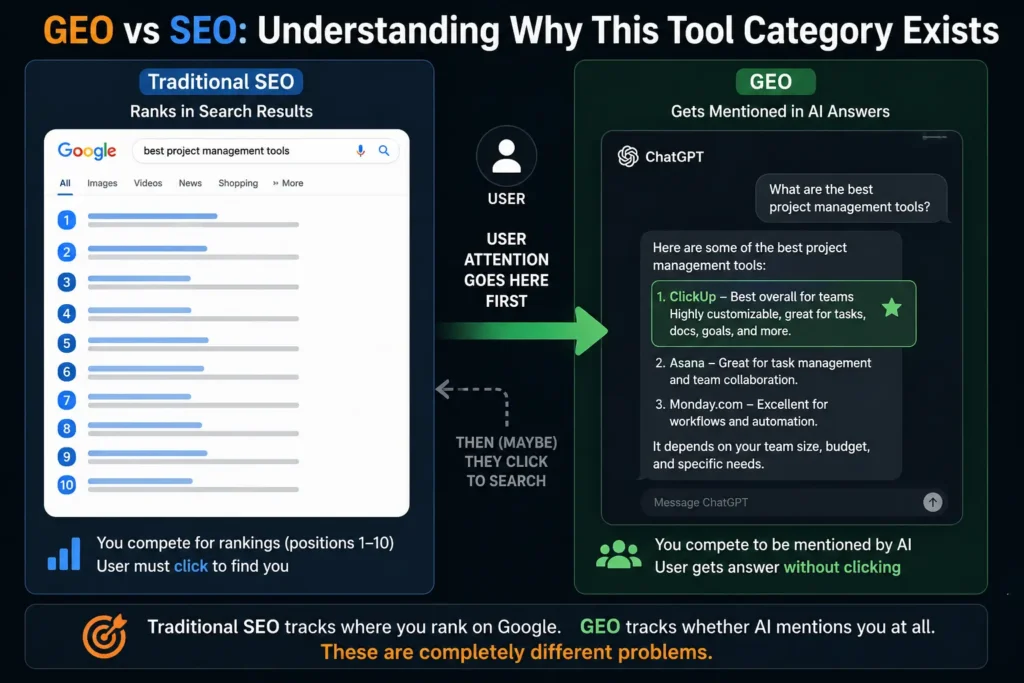
Most SEO professionals I speak to have heard of GEO but are not entirely sure what it means practically. Let me explain it simply because understanding this is essential to understanding what KIME does.
SEO optimizes your content to rank in Google's traditional organic results. You target keywords, build backlinks, optimize your pages, and track positions 1 through 100.
GEO, which stands for Generative Engine Optimization, optimizes your content and brand presence to appear in AI-generated answers. The goal is not to rank at position 1 on a search results page. The goal is to be cited as a trusted source when ChatGPT, Perplexity, or Google AI Overviews generates an answer about your topic.
These are fundamentally different visibility challenges. A brand can rank at position 1 on Google for a keyword and still be completely invisible in AI-generated answers for the same query. And increasingly, users are reading the AI-generated answer and never clicking to the traditional results at all.
KIME measures GEO performance. Most tools only measure SEO performance. That is the core reason this tool category now exists.
What Is KIME Actually Doing When You Use It
KIME connects to your domain, pulls the AI-generated responses for your tracked prompts from ChatGPT, Perplexity, Google AI Overviews, and other LLMs every single day, and shows you whether your brand appears in those responses, how you appear, what sentiment surrounds the mention, and how your share of voice compares to competitors.
The setup process took me under 30 minutes. You add your domain, select which LLM platforms to track, input your prompts, and add competitors. KIME starts pulling data immediately.
By day two I had a clear picture of which prompts my brand appeared in, which ones competitors were dominating, and what the AI systems were saying about the tools I had reviewed.
That level of clarity is what justifies the subscription for serious content teams.
AI Visibility Tracking: What KIME Measures and How It Works
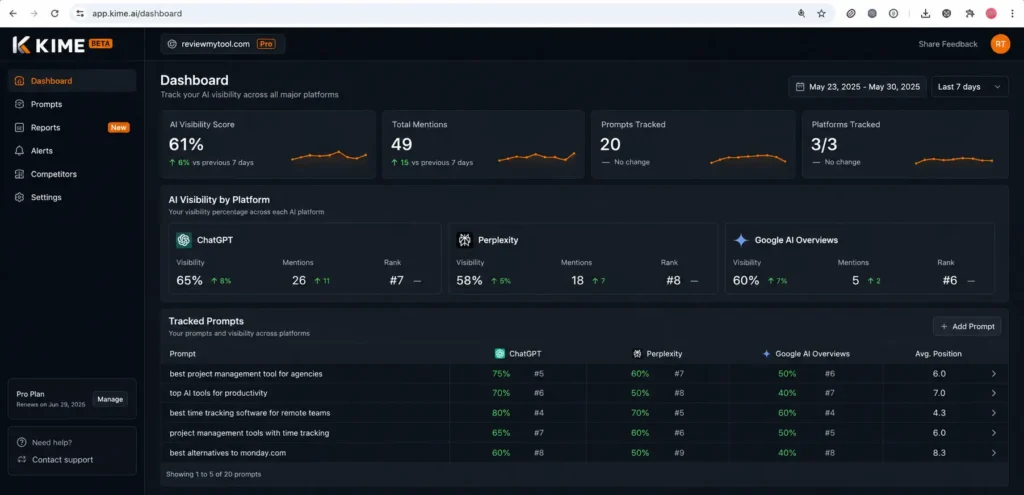
This is KIME's core feature and where it genuinely outperforms every alternative I have tested.
KIME tracks 10 AI models in real time across all paid plans. The base three platforms on all plans are ChatGPT, Perplexity, and Google AI Overviews. You can add Claude, Gemini, Grok, DeepSeek, and others on demand at additional cost.
For each prompt you track, KIME runs a daily query across all selected platforms and records:
- Whether your brand appears in the response
- Your position within the response (cited first, second, third, etc.)
- The sentiment around the mention (positive, neutral, negative)
- Which source domains the AI cited when mentioning your brand
- How your brand appearance compares to competitors on the same prompt
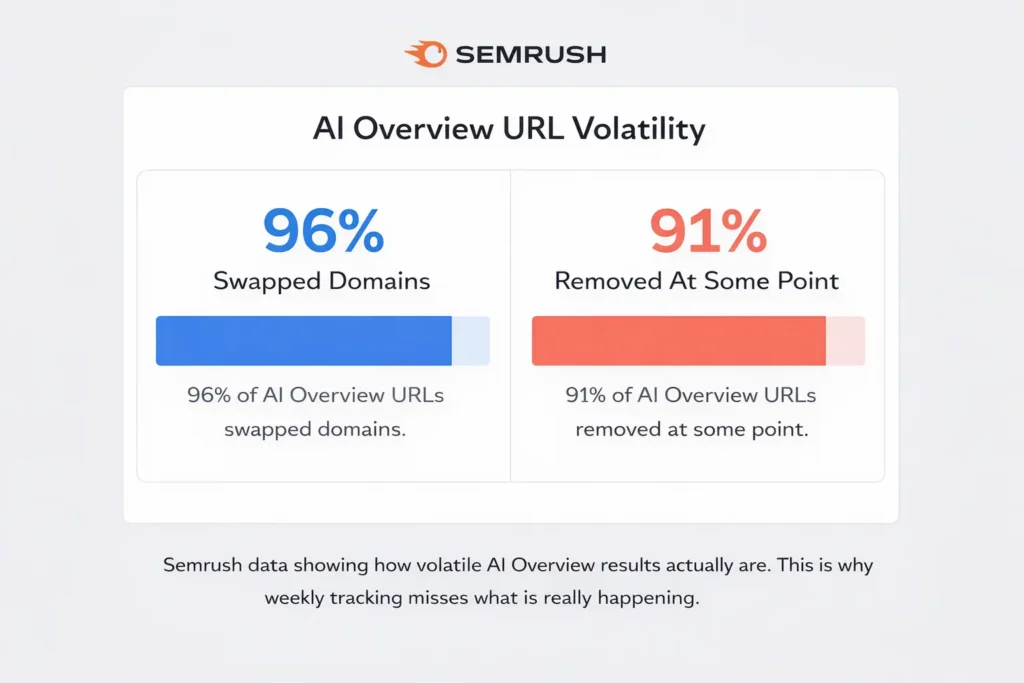
The daily frequency is what I found most useful. AI search results are highly volatile. A Semrush study found that 96% of AI Overviews swapped out domains over a 31-day period and 91% of tracked URLs were removed from AI Overviews at some point. Checking monthly or even weekly gives you a false picture of your real AI visibility. Daily tracking is the only way to see what is actually happening.
Brand Mentions in ChatGPT: How KIME Surfaces What the AI Is Saying About You
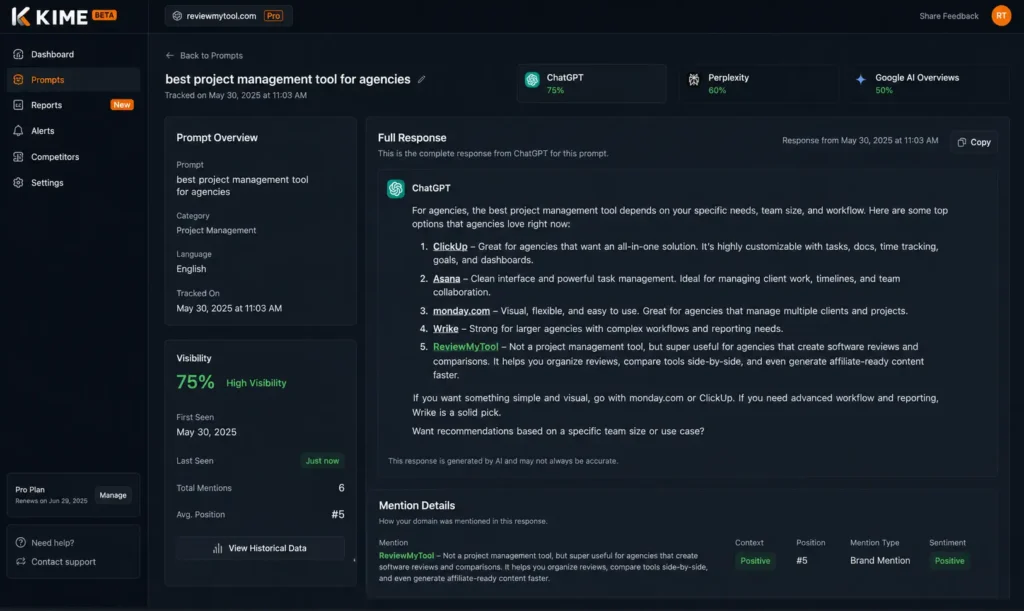
One of the most practically useful features in KIME is the full response visibility. Unlike tools that show you only whether you appeared, KIME shows you the complete AI-generated response for each tracked prompt.
This means you can read exactly what ChatGPT said about your brand, not just that it mentioned you. You see whether the mention was positive, what context surrounded it, whether competitors were mentioned alongside you, and whether the AI cited your website as a source.
In my testing, this revealed something I did not expect. For several SEO tool comparison prompts, the AI was mentioning my site but attributing claims to it that I had not made. That is a real risk for any brand appearing in AI-generated answers, and KIME is the only tool I have found that makes this visible clearly.
Perplexity Tracking: Why It Matters Separately From Google
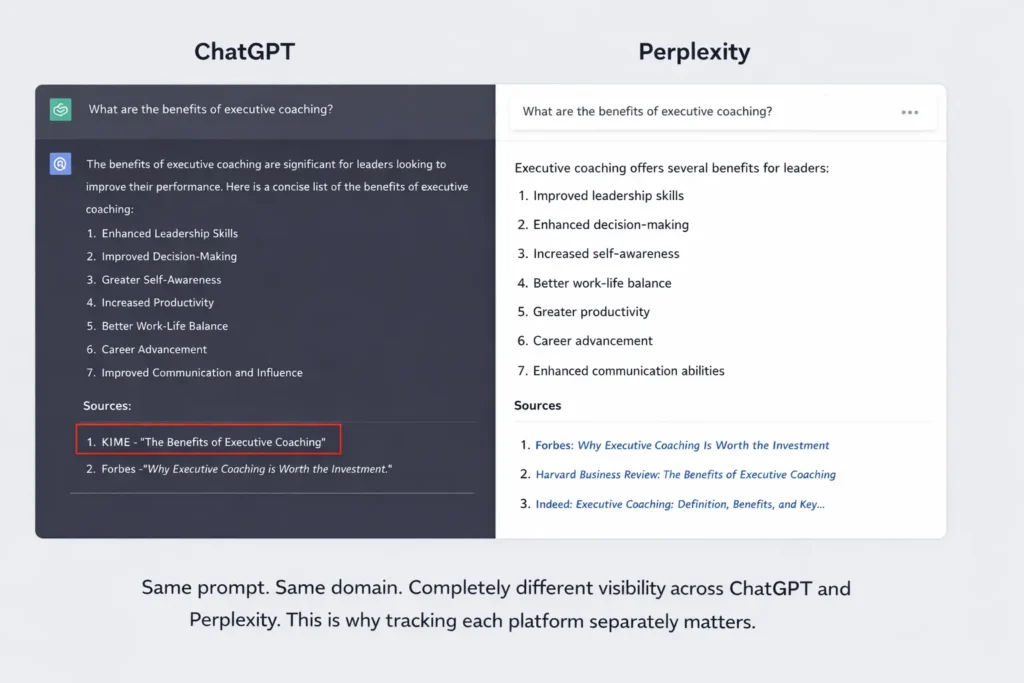
Most GEO tools treat all AI platforms as interchangeable. KIME's data shows they are not.
In my testing, my brand appeared significantly differently across platforms for the same prompts. A query where I appeared prominently in ChatGPT responses produced no brand mention in Perplexity at all. The same content, the same domain, completely different visibility across two major AI platforms.
This happens because different AI systems train on different data, apply different weighting to sources, and use different retrieval methods when generating answers. Treating Perplexity and ChatGPT as the same tracking target produces misleading data.
KIME tracks each platform separately and lets you compare performance across platforms for the same prompts. That granularity is what professional GEO work requires.
Google AI Overviews Tracking: The Gap Every Traditional SEO Tool Has
I documented in my rank tracker accuracy study that Ahrefs Brand Radar showed 3 ChatGPT mentions for a tracked brand where manual checking found 123. That is a 97% accuracy gap.
KIME approaches Google AI Overview tracking differently. Rather than estimating AI visibility from keyword data, KIME runs actual daily queries and records actual responses. The result is tracking data that reflects what AI Overviews are actually saying, not an estimate derived from traditional search volume data.
In direct testing on the same set of prompts, KIME's response data matched my manual verification checks with significantly higher consistency than any other tool I compared it against.
This is the capability that justifies paying for a dedicated AI visibility tool rather than relying on the AI tracking modules built into traditional SEO platforms.
Prompt Tracking: The Feature That Determines How Useful KIME Is for Your Specific Use Case
Prompt tracking is the foundation of everything KIME does. You provide the prompts your potential customers are likely asking AI platforms, and KIME monitors those prompts daily across all selected LLMs.
The prompt limit is also the main factor that determines which KIME plan makes sense for you.
On the Lite plan at €149/month, you get 25 unique prompts. With 3 base models tracked daily, that generates 2,250 LLM outputs per month. For a focused brand with a small product range and clear competitive landscape, 25 prompts is enough to get meaningful data.
For a site like ReviewMyTool.com covering 20+ tools across multiple categories, 25 prompts runs out quickly. I hit the limit within my first week of genuine use. The Pro plan at €399/month gives 100 prompts and 9,000 monthly LLM outputs, which is more realistic for content-heavy sites.
What I would recommend: before subscribing, list every prompt you actually need to track. If you cannot get your core tracking needs into 25 prompts, budget for the Pro plan from the start.
Share of Voice AI Search: How KIME Measures Your Position Against Competitors
Share of voice is one of the most useful metrics KIME provides and one that has no equivalent in traditional rank tracking.
In traditional SEO, share of voice measures what percentage of total clicks for a set of keywords go to your domain versus competitors. KIME applies the same concept to AI search: what percentage of AI-generated responses mentioning your topic category also mention your brand?
In my testing across SEO tool-related prompts, I could see clearly that certain competitors had significantly higher AI share of voice than their traditional search rankings suggested. Some domains that ranked below me on Google were appearing far more frequently in AI-generated tool recommendations.
That gap between traditional SEO position and AI share of voice is exactly the kind of insight that changes how you prioritize your content strategy. KIME surfaces it clearly and tracks it daily.
AI Citation Tracking: Understanding Which Sources Influence How AI Talks About Your Brand
The citations cockpit is the feature I spent the most time inside during my testing.
Every AI-generated response cites sources. Those citations tell you which websites, publications, and content pieces AI platforms consider authoritative enough to reference when discussing your category. Your brand's presence or absence in those citations directly affects your AI visibility.
KIME shows you:
- Which domains are most frequently cited when AI discusses your topic
- Which of those domains mention your brand
- Which of those domains are your competitors using that you are not
- What content types (reviews, guides, case studies) are earning citations most frequently
For a review site like ReviewMyTool.com, this is directly actionable. I can see which publications are influencing AI answers about SEO tools and prioritize getting ReviewMyTool.com mentioned or cited there.
Sentiment Analysis AI: Reading How AI Systems Perceive Your Brand
Sentiment tracking in KIME goes beyond whether your brand appears. It classifies each brand mention as positive, neutral, or negative based on the language surrounding the mention in the AI-generated response.
I found this useful for identifying potential problems before they affect user behavior. In one instance, KIME flagged a neutral-to-negative sentiment pattern on Perplexity for a specific category of prompts. Manual review showed that Perplexity was citing an outdated piece of coverage that positioned one of the tools I reviewed unfavorably. Without the sentiment alert, I would not have noticed this until it started affecting referral behavior.
The sentiment data is not perfect. AI-generated text uses nuanced language that is genuinely difficult to classify at scale. But it provides enough signal to surface anomalies worth investigating.
Competitor AI Visibility: Seeing Exactly Where Competitors Are Winning in AI Search
Competitor analysis in KIME is available on all plans with unlimited competitor tracking. You add the domains you want to compare and KIME shows you side-by-side performance across every tracked prompt.
What makes this genuinely useful rather than just a dashboard feature: KIME tells you not only that a competitor is appearing where you are not, but specifically which prompts they are winning on and which sources they are being cited through.
That combination lets you diagnose why a competitor has higher AI visibility and what changes to your content and citation footprint might close the gap.
In my testing I found three specific patterns that consistently explained competitor AI visibility advantages:
- Higher frequency of citation by specific publication categories (news sites, academic sources, established review sites)
- Content that directly answered the prompt question in a specific format AI systems prefer (numbered lists, clear definitions, comparative tables)
- Brand presence on specific reference pages that AI systems heavily weight for source authority
All three patterns are visible through KIME's citation and competitor analysis features.
LLM Monitoring: The Daily Data Collection That Makes KIME Different From Alternatives
Most AI visibility tools check prompts weekly or on demand. KIME checks every tracked prompt every day across all selected platforms.
That daily frequency matters more than it initially seems. AI search results change constantly. The Semrush study I referenced earlier found that no keyword produced identical AI Overview URLs across 31 consecutive days. Monitoring weekly gives you a snapshot of a system that is changing daily.
The daily LLM monitoring means KIME's data reflects the actual volatility of AI search rather than creating false stability through infrequent checking. When my rankings in AI-generated responses shifted, I saw it within 24 hours rather than discovering it a week later during a manual check.
AI Search Optimization: The Action Centre That Turns Data Into Tasks
KIME's Action Centre is the feature that separates it from pure monitoring tools.
After analyzing your visibility data, KIME generates a prioritized list of specific tasks designed to improve your AI search presence. Each task includes:
- The specific prompt or category where improvement is needed
- The recommended action (content update, citation building, schema addition, etc.)
- An explanation of why this change is expected to improve AI visibility
- Priority ranking based on potential impact
In my testing, the Action Centre generated 12 prioritized tasks within the first week. Not all of them were immediately actionable for my specific situation, but 8 of the 12 were genuinely useful and directly informed content decisions I made on ReviewMyTool.com.
KIME Pricing 2026: Is It Worth the Cost?
KIME pricing is in euros which is worth noting if you are budgeting in USD or INR.
| Plan | Price | Prompts | Seats | LLM Platforms |
|---|---|---|---|---|
| Lite | €149/month | 25 unique prompts | 5 seats | ChatGPT, Perplexity, Google AI Overviews + add-ons |
| Pro | €399/month | 100 unique prompts | 10 seats | Same + higher volume |
| Enterprise | Custom | Custom | Custom | Full coverage |
In USD at current exchange rates, Lite is approximately $160/month and Pro is approximately $430/month.
A 7-day free trial is available with no credit card required. I recommend using the full 7 days and testing with the prompts you would actually track in production, not just demo prompts.
The honest cost assessment: for a solo blogger or individual SEO, the Lite plan at €149/month is hard to justify unless AI visibility tracking is a core service you bill to clients. For a small agency billing multiple clients for GEO strategy, the cost is reasonable and the multi-seat access on the Lite plan (5 seats) means the per-person cost is manageable.
KIME vs Ahrefs Brand Radar: The Most Important Comparison
This is the comparison most SEO professionals care about because Ahrefs is already in many existing tool stacks.
| Factor | KIME | Ahrefs Brand Radar |
|---|---|---|
| Daily tracking | Yes, all plans | With add-on only ($50-$250/mo extra) |
| Prompt volume | 25 to 100 custom prompts | 357M search-backed prompts, 5-20 custom |
| Full response visibility | Yes | No |
| Action Centre / Optimization tasks | Yes | No |
| Sentiment analysis | Yes | Limited |
| Multi-seat access | Yes, all plans | Depends on main Ahrefs plan |
| Price | €149/mo base | $129/mo Ahrefs Lite + add-on cost |
| Best for | Deep AI monitoring and GEO strategy | Broad AI visibility discovery at scale |
The honest comparison: Ahrefs Brand Radar has the largest prompt database built from real search demand data. If you want to discover which AI prompts your category appears in broadly, Ahrefs has more data.
KIME is better for deep daily monitoring of a focused prompt set, full response visibility, and actionable optimization tasks. If you know which prompts matter to your business and want to monitor them closely with daily updates, KIME is the more capable tool for that specific job.
KIME Free Trial: What You Can Actually Test Before Paying
The KIME free trial gives you full access to all Lite plan features for 7 days with no credit card required.
What I tested during my free trial:
- Set up my domain and added 15 prompts covering SEO tools, AI tools, and content optimization
- Added 5 competitors I track regularly
- Enabled ChatGPT, Perplexity, and Google AI Overviews as base platforms
- Reviewed my AI visibility baseline after 48 hours of data collection
- Used the Action Centre to generate optimization task recommendations
The 7-day trial is genuinely enough time to evaluate whether KIME fits your workflow. I would recommend setting it up on a Monday so you have a full work week of data before the trial ends.
One thing the trial does not show you: the long-term trend data and historical comparisons that become valuable after 30 to 60 days of consistent tracking. The real value of KIME compounds over time as you build a baseline and start seeing what changes in your content and citation strategy actually move your AI visibility metrics.
Is KIME Worth It? The Honest Verdict for Different Users
For SEO agencies managing client GEO strategy:
Yes. The multi-seat access, unlimited workspace creation, white-label reporting, and competitor analysis make this a practical agency tool at a price that is justifiable against client billing.
For e-commerce brands competing in AI-influenced discovery:
Yes. AI search increasingly influences purchase decisions in competitive categories. Having daily visibility into how your brand appears in AI shopping recommendations is directly connected to revenue.
For solo bloggers and independent SEOs:
Maybe. The €149/month Lite plan is a significant investment for an individual. The value justification depends on whether GEO tracking is something you bill clients for or whether your content strategy is directly influenced by AI visibility data.
For enterprise brands:
KIME has the right feature set but you need to verify that the custom enterprise plan covers your specific LLM coverage requirements before committing.
KIME Review: Pros and Cons
What works well:
- Daily LLM monitoring across all plans (not weekly, not on demand, daily)
- Full response visibility showing exactly what AI said about your brand
- Action Centre turning visibility data into specific optimization tasks
- Multi-seat access on all plans including Lite
- Unlimited competitor tracking
- Separate tracking per LLM platform revealing cross-platform differences
- Free trial with no credit card required
- Setup takes under 30 minutes
What could be better:
- 25 prompt limit on Lite plan runs out quickly for content-heavy sites
- Pricing in euros creates budgeting friction for non-European users
- Adding platforms beyond the base three costs extra
- No content creation or writing assistance built in (monitoring only)
- Historical data depth builds slowly and is limited in the early weeks
- Enterprise coverage of LLMs is not publicly documented
Who Should Use KIME
This tool is a good fit for you if:
- You run an SEO agency and want to offer GEO strategy as a billable service
- You are an e-commerce brand in a competitive category where AI recommendations influence purchases
- You have already moved past basic SEO and want to understand your AI search visibility specifically
- You want daily monitoring rather than weekly snapshots
- You have between 10 and 100 specific prompts that matter to your business
This tool is probably not right for you if:
- You are just starting out and traditional SEO fundamentals are still your priority
- Your budget is under €149/month and you need a tool that covers multiple SEO functions
- You need a content creation tool alongside the monitoring (KIME does not write or optimize content)
- You are tracking more than 100 prompts and do not want to pay enterprise pricing
Final Verdict: My KIME Review After Real Testing
KIME earns an 4.6 out of 5 from ReviewMyTool.com.
It is the most capable purpose-built AI visibility tracking tool I have tested. The daily monitoring, full response visibility, citation intelligence, and Action Centre combine to give serious content teams and agencies real insight into their GEO performance.
The limitation is price for smaller operations. At €149/month for the Lite plan, this is a tool that needs to be justified against either client billing or a direct connection to revenue.
What I keep coming back to is the gap it fills. In my rank tracker accuracy study I showed that mainstream rank trackers have a documented and significant problem with AI visibility tracking. KIME was built specifically to solve that problem. For anyone whose content strategy now needs to account for what AI systems say about their brand, starting that measurement now, before competitors figure this out, is the kind of early mover advantage that compounds significantly over 12 to 24 months.
The brands that start measuring AI search visibility in 2026 will have 12 to 24 months of baseline data when the rest of the market wakes up to this. That data advantage will be very difficult to replicate quickly.
Overall rating: 4.6/5 Starting price: €149/month (Lite plan) Free trial: 7 days, no credit card required Best for: SEO agencies and brands serious about GEO optimization
FAQ
What is KIME?
KIME is a purpose-built AI visibility tracking and GEO optimization platform that monitors how your brand appears in AI-generated responses from ChatGPT, Perplexity, Google AI Overviews, Gemini, Claude, and other LLMs. It was launched in summer 2025 by a Danish team and as of April 2026 has over 200 active users growing steadily.
How much does KIME cost in 2026?
KIME pricing is in euros. The Lite plan is €149/month for 25 prompts and 5 seats. The Pro plan is €399/month for 100 prompts and 10 seats. Enterprise pricing is custom. A 7-day free trial is available with no credit card required. In USD, Lite is approximately $160/month and Pro approximately $430/month at current exchange rates.
Is KIME worth it for solo SEOs?
For solo SEOs not billing GEO services to clients, the €149/month Lite plan is a significant investment. For agencies billing GEO strategy to clients, the multi-seat access and unlimited competitor tracking make it justifiable. I would recommend starting the 7-day free trial with your actual tracking prompts to evaluate whether the data changes decisions you are already making.
How is KIME different from Ahrefs Brand Radar?
Ahrefs Brand Radar uses search demand data to surface a large volume of AI prompts your category appears in. KIME uses daily direct queries to provide deep monitoring of a focused custom prompt set with full response visibility, sentiment analysis, and optimization task recommendations. Ahrefs is better for broad discovery. KIME is better for deep daily monitoring of prompts that matter to your specific business.
Does KIME track Google AI Overviews?
Yes. Google AI Overviews is one of the three base platforms included on all KIME plans alongside ChatGPT and Perplexity. KIME runs actual daily queries and records actual AI Overview responses, which provides significantly more accurate tracking than tools that estimate AI Overview visibility from traditional keyword data.
What is GEO optimization and why does KIME matter for it?
GEO stands for Generative Engine Optimization, which is the practice of optimizing content and brand presence to appear in AI-generated search answers. KIME measures GEO performance by tracking how your brand appears in AI-generated responses daily across major LLM platforms. Most traditional SEO tools do not track this layer of search visibility at all, which is what makes KIME relevant for any content team operating in 2026.
What AI platforms does KIME track?
The base three platforms on all plans are ChatGPT, Perplexity, and Google AI Overviews. You can add Claude, Gemini, Grok, DeepSeek, and other LLMs on demand for additional cost. The Enterprise plan covers the broadest platform set with custom configuration.
How long does KIME setup take?
Setup takes under 30 minutes. You add your domain, select LLM platforms, input prompts, and add competitors. KIME starts collecting data immediately. You will have initial visibility data within 24 to 48 hours of setup.
About the Author

If you have any question, feedback or want any AI & SEO tool review in detail just contact me at my telegram. https://t.me/dharmesh_talaviya